Friday, May 10, 2013

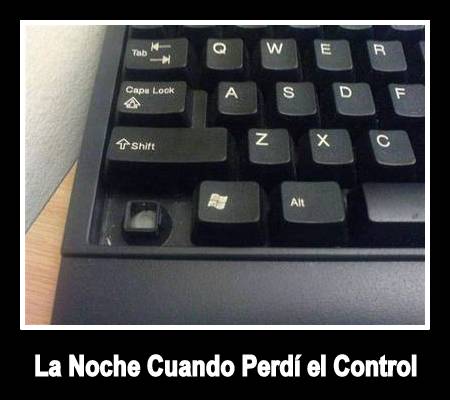
La Noche Cuando Perdí el Control

Sometimes I see funnies online in English and I think that I'd love to share them with my Spanish students - if only they were in Spanish.  Other times I gather the time and energy to recaption them myself.  My graphic software is not working with my current computer and that makes me sad but, with Picassa I can add a border and a caption without any need for all the bells and whistles in CorelDraw. 

And the great thing is that this joke is funny in both English and Spanish.  Well, I think so anyway.


I'm thinking I need to find a picture (or take one) with a missing escape key too.  I could caption it "No hay escape."  Funny, right?  That one would be especially poignant on the eleventh day of class - when students are no longer allowed to drop the course. 

Buen fin de semana, amigos.  Nos vemos pronto.

--AnneK

Thursday, May 9, 2013

Premios de Oro en el Examen Nacional

My school has all the foreign language teachers give the national exams every year.  I'm not exactly sure why, to be honest.  The material covered by the National Spanish Exam is very different than what we cover in class.  The grammar is right on target with what I teach from year to year but the vocabulary is unrelated to that which we cover in our textbook and far more extensive.  For example, I do not cover astronomical terms or celestial bodies with my Spanish III students but that material is on the test.  Nor do I discuss world religions, philosophy, and dogma with my Spanish IV students, but again that material is on the test.

It becomes a challenge every year to decide what to include and what to exclude from the list of NSE vocabulary.  I want to focus on pragmatic vocabulary to what extent I can and I certainly do not want to overwhelm my students.  So, do I include a lesson on astronomy or not?  It's the sort of question I have to repeatedly ask myself as I am lesson planning.

For years I've had students do well on the exam for the most part.  But, as the vocabulary gets more and more distant and my textbook series diverges from the NSE vocabulary from year to year, my students in the upper levels score lower on the tests than my students in the lower levels.

And in all my seven years giving this test, I've never had a student score in the top 5% of the nation and get a gold medal . . . until this year.  This year I had, not one, but TWO students score gold medals - both of them in Spanish III.  I also had a student get a silver medal, several students got bronze medals and there was a whole slew of honorable mentions.  I'm so proud of them I could just burst, honestly.

I think I'll make a bulletin board to celebrate them.  I think it is important to showcase academic achievements because not everyone is a star athlete or a brilliant singer.  And schools have a way of putting the spotlight on athletic and arts achievements while sometimes overlooking academic ones.  Probably because sports programs and band competitions are competitive and those students come home with medals whereas the students who are academic achievers tend not to bring home trophies and the like.  I already asked our local PTA for money for a pizza and ice cream party for next year but a bulletin board and an awards ceremony will be just the thing to make it a real celebration of excellence.

Hasta pronto,

--AnneK

Wednesday, May 8, 2013

¿Más Zombis?

Zombies.  They are everywhere, I tell you!

So I came across this delightful little zombie picture story on Pinterest and a fellow Spanish teacher suggested it would be great to have the students tell the story that goes along with the pictures.  The picture is rather large, so you will have to click on it to see it in its full glory.

-->
Telling stories with pictures has a long and rich tradition in the foreign language classroom because it allows us to communicate in the target language without having to resort to translation.  But there are some challenges to overcome when we want our students to speak in a more sophisticated way.

Some of the pitfalls of storytelling with pictures that I have seen over the years are, 1) The students seem to feel a need to put things into order with ordinal numbers.  This makes a story less interesting in my opinion, and it also invariably breaks down when the students forget what comes after primero y segundo . . .  2) They insist on using the present progressive tense.  Stories are most often told in the past tense - not in little tiny tidbits of present progressive encapsulated in a numbered sequence.

Perhaps the best way to deal with the situation is to remind the students about various transitions we can use in Spanish to make our writing and speaking more fluid.  Maybe we could even give them examples in their own language of how writing sounds better with transitions?  This sounds like a good way include language arts instruction with the lesson.  Maybe an English teacher would like to collaborate with you?

Here are some of my favorite transitions in Spanish:

  • al principio - in the beginning
  • Había una vez. . . - Once upon a time. . .
  • entonces
  • luego - then
  • más tarde - later
  • mientras tanto - meanwhile
  • mientras - while
  • pronto - soon
  • dentro de poco - soon, shortly
  • tan pronto como - as soon as
  • en cuanto - as soon as
  • finalmente - finally
  • por último - finally
  • por fin - in the end, finally

I thought I'd finish up with a couple of assignment ideas.  I've written the instructions in English.  There seem to be two camps of thought on whether instructions go in English or Spanish.  Though my heart tells me it should be all Spanish, my head lives in reality and knows that some of my students (especially those with special needs) the parents, and special needs case workers need the English translations.  If you are in the Spanish-only camp, feel free to translate the instructions.

Assignment: Tell the story that you see in the pictures.  Do not feel like you need to address every single photo individually.  Instead tell the story holistically.  Do not use the ordinal numbers (primero, segundo, tercero, etc.); use transitional words and phrases to move your story along.  Try to use at least five of them in your narrative.  Use the preterite tense to talk about the action that occurs in the story and use the imperfect for descriptions and ongoing situations (was/were "verbing").  Be prepared to share your story with the rest of the class.

More Fun: Do the story together as a class and generate the list of transition words together as a group.  Carefully highlight the use of preterite and imperfect as you go along.  (Maybe highlight the preterite in one color and the imperfect in another?)  Then, put the students into groups and let them create their own story together.  They should have 5-10 pictures in sequence when they are done.  Let them share their pictures and their story (En español, por supesto.) with the rest of the class.  Fun, right?  Just remind them that their story must be school appropriate.  

Hasta pronto amigos,

--AnneK

Thursday, April 18, 2013

La Tragedia en Boston

I really struggle with terrorism.  The killing of innocent people to draw attention to one's dogma, be it religious or social, is unfathomable to me.  In Boston today, people who never had anything to do with whatever religious or social agenda the bomber had in mind are burying their loved ones and learning to cope with new disabilities.  The world is diminished.

Students sometimes want to talk about these things and that is not something that can be done easily (if at all) in the target language.  Regardless, my current Spanish II chapter vocabulary has such words as explosion, smoke, fire fighters, paramedics, and other related words on the list.  And we are using preterite and imperfect to discuss the past, so I decided that we could cover this topic.


I wrote a description of the event in very simplified Spanish and included a picture to help with comprehension and discussion.  Then I found a short video (40 seconds) in native Spanish covering the tragedy as well.  As these things go, the Spanish in the video is reasonably approachable for a late-year Spanish II student with sufficient teacher scaffolding.  To do that, I created a series of mini activities with different objectives so they could watch the video several different times.  Each time they watched the video again, they would be looking/listening for something different.  6th period gave a thumbs up at the end of the activity and said they were able to understand, if not every word of the video, at least the big picture of what was going on overall.


I left a spot for the students to write some thoughts and reflections at the end.  These points could be used in small or large group discussions, if your students are good at that and can be trusted to stay on topic.

When I finished with the activity today, I offered it to the other Spanish teachers here and they were positive about it.  So now I share it with you and hope your students can have some success with Spanish and staying abreast of current events.  Perhaps it will give them a voice to their thoughts.

My love and prayers go out to the victims of the explosions and to their loved ones.  God bless you all.

Hasta pronto,

--AnneK

Thursday, April 11, 2013

Otros Usos Para Un Viejo Calendario

I was tired of looking at a bulletin board which had been put up weeks ago and had faded, deteriorated, and become unappealing.  And some little troglodita had even deposited a wad of gum on it - yuck!

But I had no time, supplies, or inspiration to create a new bulletin board from scratch . . . and then it occurred to me.  I had an old calendar from last year that was just sitting around collecting dust.  I hadn't thrown it away because it had such beautiful pictures and I was hoping to find something to do with them, and today turned out to be the day.

What do you think?
Colorful, bright, festive and done in less than fifteen minutes!  

Of course it would be more educational in nature if I put up a little blurb about what each of the pictures were, but see above about time and inspiration.  Perhaps I'll find a little stash of one or both at the end of the week.

The calendar was from the good folks at Teacher's Discovery who create wonderful classroom supplies for teachers - especially us language teachers.  They included it as a freebie with my order last time.  What a wonderful gift!

Hasta pronto,

--AnneK

Wednesday, April 10, 2013

Pensamientos Sobre Mi Escuela

I often hear students exclaim loudly about how much they hate school, or how much they hate this school in particular.  Do they imagine that at other schools, students leap out of bed each morning excited about another day of learning?  Do they sing and dance at the bus stop because they are so overjoyed about their school?  Perhaps they think that other schools are all YouTube videos, funny memes, and taco parties? 

School is hard, no matter where you are, and there are always challenges to be faced.  That said, I teach at a wonderful school.  My students are bright and respectful.  The teachers are dedicated, knowledgeable, and so hard-working.  The administrators are in touch with the realities of the classroom (both the principal and the assistant principal teach classes of their own) and are available to talk when needed.  The school building is new and has wireless internet throughout, interactive white boards, Apple TV displays on high-def screens, document cameras, and all sorts of other goodies.  And, as if all that were not enough, all the students in the school are issued an iPad and a suite of apps that they use to complete their assignments, research, and connect with others.  We have no discipline problems to speak of, no issues with teen pregnancy, drug abuse, hazing, or violence.

Our test scores on the PSAT, ACT, and state exams are consistently (and significantly) higher than those in the state and in the county.  It's a utopia, right?

What is the problem?  Why would students complain so vehemently about our school?

The have one legitimate gripe, I suppose.  (Not really, but I'll voice it for them here anyway.)  The students wear a "uniform" (polo shirts and khakis) and they hate it.  And, because we are a school of choice (a public charter) families opt in to this school instead of the local public schools.  Classes here are hard and we don't pass kids along who don't meet academic expectations.  So some students feel like if they could just be at the local public high school, it would be a constant party.

The thing they forget is that school is supposed to be hard.  It's supposed to challenge you, stretch you, and push you to your maximum potential.  It's supposed to break you out of conformist thought and provide new perspectives.  In school and in life one is supposed to work hard and go home tired but satisfied with a sincere effort and progress toward goals.  Otherwise, what is the point?

I once saw a button that said, "School prepares you for the real world, which also sucks."  Now, I don't believe that hard work need be considered a bad thing, but it is true that school is a lot of work which prepares you for a lot more work.  And that is a good thing, amigos!  We do not want to be intellectually complacent any more than we want to be physically sedentary.  Both lead to rot and ruin and we cannot allow our kids to choose that for themselves without putting up a fight.

Our education is perhaps the only thing in life that we own completely.  It is something that can never be taken from us, even by the most oppressive regimes or religions.  It's worth the struggle and it's worth the work.

So the next time I hear some kid talking about how much school sucks or how awful it is, I need to respond with something along the lines of "It's a lot of hard work, isn't it?  But anything worth having in life is worth working for."

Mis pensamientos de hoy, amigos.

Hasta pronto,

--AnneK

Tuesday, April 9, 2013

Yo No Pudiera Decirlo Mejor

Every now and again I stumble across something that is just perfect.  The message and the way it is written coincide to produce an ideal little snippet of wisdom and insight.

People, and I think teens are even more susceptible to this, often tend to think that morality begins and ends with a label.  Obviously it's not enough to label yourself "religious" and be done with it.  Like the old adage suggests, "Your words are who you want others to think you are but your actions are who you really are."


I try very hard not to get hung up on people's belief systems, but rather to accept them for who they are and judge them by their actions (if and when judgement is even called for).  But crowing loudly about one's religion or one's atheism is one of those things that puts me on alert.  Are you really that devout or do you just want me to think that?

But to bring this around to a classroom topic, that is why I am here after all, what does one do when the classroom suddenly bursts into a discussion of religion?  Such debates are frequently so passionate that students do not maintain the target language and are almost always off-topic.  But I feel like an intellectual ogre when I stomp on the discussion and try to bring it back around to the pluscuamperfecto (or whatever the topic at hand might be).

Maybe one could redirect by saying that the conversation has strayed from the topic at hand, but that students were welcome to submit comments in Spanish for later discussion and then give them a forum to do so.  A discussion board online might be ideal, as long as rules were posted that no proselytizing and no slandering would be allowed.  My experience tells me that only a very few would actually take me up on it, but that it could be a brilliant discussion for those who did.  What do you think?

Hasta pronto,

--AnneK

Image courtesy of www.desmotivaciones.es .

Monday, April 8, 2013

¡Más Zombis!

And a little something to add to the Zombie Apocalypse lesson . . .


And look!  It even has an example of the imperfect subjunctive and the conditional to reinforce the lesson on conditional.  Who could ask for more?

Gracias to the folks at www.desmotivaciones.es for the image.  You will find a lot of funny stuff over there but be cautious, not all of it is classroom appropriate.

Hasta pronto,

--AnneK

Wednesday, April 3, 2013

Apocalipsis de Zombis

Zombies are big right now though I can't begin to understand why.  I mean, they really don't have anything going for them.  They look bad, smell bad, make a mess everywhere they go, and they want to eat your brain.  Not good.

But still they persist in popular culture.  It seems that I see a new zombie video or hear talk of surviving a zombie attack every other day.  So my students were quite taken aback today when I told them we were going to plan for the zombie apocalypse.  Yes, really.  It's a great way to use the conditional tense in Spanish.

http://i2.ytimg.com/vi/9ctJ6I-4NJ8/mqdefault.jpg

I discovered this delightful video on YouTube in which Señor Jordan teaches the use of the conditional tense.  He explains (in Spanish) about people becoming sick and turning into zombies.  Then he poses the question: ¿Qué harías?  He goes through a number of suggestions for how to best respond and then pauses for the listener to decide whether the idea is a good one or bad one.  He goes on to explain the conditional tense and does a few practice activities as well.  All told, an excellent and entertaining educational video.

http://i4.ytimg.com/u/3I2scc15jBct61vlxt3zcw/channels4_banner.jpg?v=515a2cdf 

My students really liked the video too.  It's great to hear them laughing and enjoying themselves in class, I must say!  We followed up the video by working in pairs to generate ideas about what to do to survive the coming of the zombies.  They were given instructions to include at least one mala idea also, and that made the activity especially fun.

"Iría a Wal-Mart y compraría comida enlatada, botellas de agua, y otras provisiones."
"Jugaría videojuegos de zombis para mejorar mis habilidades de matarlos."
"Juntaría armas de fuego, municiones, y minas terrestres."
"Estudiaría para mis examenes AP."
"Iría a Fort Bragg para pedir ayuda militar."
"Les enseñaría bailar (a los zombis)"

I'm putting the best ones together in a Powerpoint and we will decide which ones are the good and which ones are the bad ideas.  And I'm going to award a Most Likely to Survive a Zombie Apocalypse certificate to the group with the best plan overall.

And, as I type this, the male members of my family are discussing their own survival strategies - in all seriousness.  I wish you could hear this.  They have thought this through and have strong opinions. *eye roll*

At any rate, maybe you can work a zombie apocalypse into your lesson plans too.  It's a lot of fun and your students will think you're amazing.

Hasta la próxima,

--AnneK

Friday, February 8, 2013

El Pollito Pío

A colleague of mine came across this precious video on YouTube.  It's colorful, the animations are adorable, it teaches the names of common animals in Spanish and the sounds they make, and the tune is so catchy that you'll be singing it all day. 


I am given to understand that the original was in Italian, but little Pollito Pío is available in all sorts of languages now from Dutch to Greek.  Some of the English translations are a little sketchy  ("Cock" instead of "rooster" for example.  And I've never known an American chicken to say "co co" so that might be a British or Australian thing?)

Of course, since I'm a teacher, I had to make an activity to go along with the little video.  It's a moral imperative when you've been in the profession as long as I have.  I thought I'd share it with you here.  I do not hold the copyright to any of the pictures; those belong to the original creator.  So do not copy them except for personal and educational purposes, please.


Click here or click the above picture to download a copy of the activity page.  It is best suited to middle school or high school students because, despite the seemingly juvenile content, the video is fast and youngsters won't be able to write that quickly.  Even my highschoolers needed me to pause the video a couple times so they could write.

I hope you enjoy it!  If you do, please consider leaving me a little note and letting me know.  It would mean a lot to me.

Hasta pronto,

--AnneK

Wednesday, January 16, 2013

Demasiado Enfema

My school is on a modified year-round calendar and we track-out every nine weeks for three weeks of vacation, which can be such a relaxing and restful time.  Winter track-out is my favorite because I'm recovering from midterm exams and pressures and because I have the holidays to look forward to.  My mother, who lives in my house, was struck with the flu in mid December and my three-year-old son also caught it.  And this year's version of the flu is especially bad - so the house was filled with miserable people, coughing, and complaints instead of the Ho Ho Ho I've come to expect at the holidays.

To make matters worse, on Christmas Eve I felt a bladder infection coming on and I wasn't able to ward it off with water consumption alone.  I held out as best as I could, but finally had to go the the urgent care at about 4 pm on Christmas Day - the only doctor's office open in all the city.  It was a long and uncomfortable wait and I was told that, in addition to the infection, I also had glucose in my sample and would need to see my primary care physician to get a test done for diabetes.

The next day I was in Dr. Nigalye's office getting my blood sugar tested.  The good news is that neither the sample I gave that day nor the blood drawn for the long-term test showed any sign of high blood sugar.  But the bad news is that, no matter what I did, the symptoms of the bladder infection wouldn't go away.  I did a course of Cipro and then another course of another antibiotic and I drank water with religious devotion.  My symptoms lessened and became manageable as long as I kept drinking large quantities of water, but they never went away.  And Heaven forbid I should skip a glass of water!  I would be in immediate pain again.

The track-out was spent surrounded by illness - that of others and eventually my own.  My doctor could not find anything in my sample and has referred me to a urologist.  In the meantime I've gotten the worst cold of my life - no exaggeration.  I'm on day ten of it now and still have a cough and sinus congestion.  I've missed three days of work here at the beginning of the spring semester and I'm just sick and tired of being sick and tired now.

Those plans for making Christmas art?  Nope.

Lesson plans for the first weeks of school?  No.

Clever things to share here?  Nada.

Unit plans for sale on Teachers Pay Teachers?  Didn't happen.

Christmas cookies and other baked good?  No, but my mom took up the slack for me.

Blah, blah blah!

I have my appointment with the urologist tomorrow.  Hopefully he will know what to do and will have good news for me.  *fingers crossed*

Hasta pronto amigos,

--AnneK

Tuesday, December 11, 2012

Tarjeta Digital de Navidad

Amigos,

I was playing around with my graphics program last weekend and I put together this image of the nativity.  I decided to write "Feliz Navidad" on it and make it into a digital Christmas card.  I hereby offer it up to you and to the public domain.  However, if you do use it for something (especially something commercial) I would consider it a kindness if you linked back here.  I don't get much work as a graphic artist, but every little bit helps.


I will probably create some more in the coming days and share those here as well but, in the meantime, I hope you have a feliz Navidad.

Hasta pronto,

--AnneK

Monday, December 10, 2012

Para Estudiar Los Verbos

I admit that I love grammar; it's no secret.  My friends and my students give me that askance look when I talk about it, as though appreciating the rules of the language is something akin to liking having your blood drawn at the doctor's office.

I try to keep things simple for my students.  They do not share my love for structure so I try not to bore them with long explanations and complicated drills.  Textbooks these days are very light on structure - something I think is a mistake, but I acknowledge that there are differing opinions out
there.


Here we are in exam season again: midterms for those of us on traditional schedules and finals for those on block schedules.  And, as I was pouring through my files, I came across this verb organizer that I created for my students.  The idea is to have all the tenses in one place so they don't have to page through their notes and look for them.  This particular organizer is for Spanish II; it includes present tense, preterite, imperfect, and future.  I didn't have room for conditional tense but, if I'm perfectly honest with you, I often fail to get that far in the textbook most years.

I hope you find a use for it but, perhaps more importantly, I hope your students find a use for it.

Hasta Pronto,

--AnneK

Tuesday, December 4, 2012

Coca-Cola y Navidad - Un Anuncio Lindo

I'm not one to go mixing school and commercialism often, but this is a nice commercial by Coca-Cola with approachable lyrics and culturally-relevant video.  So I figure, with an explanation that I'm not promoting the product up front, it can be used in the classroom context.

Video Link: http://www.youtube.com/watch?v=tiwgCHSZYI8 

The singer is David Bisbal and he is very easy to understand.  Still, I printed out the lyrics and a link to the commercial on a little worksheet so the students could see the words that they aren't able to hear.  Okay, so there isn't any work on the worksheet . . . maybe it's more of a "funsheet."   I'm gonna go with that.

Click on the picture to download the "funsheet."
 I will share it with my students after midterm exams.  I hope someone else out there finds it useful too!

Hasta Pronto,

--AnneK

Saturday, December 1, 2012

Mi Burrito Sabanero

Even after years of studying Spanish and spending a Christmas season in Mexico, I am still discovering new things about the celebration of the December holidays in the Spanish-speaking world.  One of those things is the traditional carol, Mi Burrito Sabanero, which is about the donkey that the Virgin Mary rode into Bethlehem.  (At least that is what I'm told it is about.  The lyrics seem to tell a story about a boy and a donkey going to visit the baby Jesus.  But who am I to argue?)


The lyrics are traditional, so I'm guessing that they are in the public domain.  Here they are:

Con mi burrito sabanero
voy camino de Belén
Con mi burrito sabanero
voy camino de Belén
si me ven si me ven
voy camino de Belén
si me ven si me ven
voy camino de Belén

El lucerito mañanero
ilumina mi sendero
El lucerito mañanero
ilumina mi sendero
si me ven si me ven
voy camino de Belén
si me ven si me ven
voy camino de Belén

Con mi cuatrico voy cantando
mi burrito va trotando
con mi cuatrico voy cantando
mi burrito va trotando
si me ven si me ven
voy camino de Belén
si me ven si me ven
voy camino de Belén

Tuqui Tuqui Tuquituqui
Tuquituqui Tu qui Tu
Apúrate mi burrito
que ya vamos a llegar
Tuqui Tuqui Tuquituqui
Tuquituqui Tu qui Tu
apúrate mi burrito
vamos a ver a Jesús

iTunes has a couple of good versions of the song that you can download for less than a dollar and share with your students.  Mine really enjoyed the song and got a big kick out of the tuqui tuqui tuqui part especially.

Hasta Pronto,

--AnneK

Image Source:  http://kimbanda7lineas.ning.com/group/navidad/forum/topics/villancicos-mi-burrito-sabanero