Wednesday, May 22, 2013

Rúbrica Para Actividades Orales

"We're tired of worksheets," they said.  I had given them a total of two over the past two days and I had thought that they were a good review as we approach final exams.  But there you have it - no more worksheets were wanted.

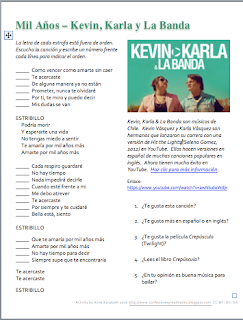
So we needed to review the dreaded preterite vs. imperfect today and worksheets were out of the question.  We did a little practice activity and corrected it in class.  Then I pulled a song out of the archives and we used it to discuss preterite, imperfect, and the uses of both.  (See this old post on the brilliant song, Tu falta de ortografía.)  But there are discussion questions on the sheet and I didn't want to assign them to be written (because that would make it a "worksheet"), and I knew that if we did them as a discussion in the large group that not everyone would participate.

So I assigned the questions as an oral activity.  Students were given some time to prepare their answers and then I called them to my desk individually and asked them one of the three questions at random.  They were told that they would not be allowed to read their response.  They had to speak from memory.  I graded them with a super simple speaking rubric which I'm sharing with you here today.


This is a good activity because students prepare answers to all three questions and when they know they are being graded on their vocabulary, pronunciation, thoroughness, and grammar, they really go out of their way to prepare good responses.  The discussions I heard around the room made my heart all warm and fluttery in a good way.  (Is that ser or estar?  Don't forget to make it feminine.  No, you say it like this . . . because there is an accent mark on it.  Etc.)

Now here is where it becomes fun.  I let them roll dice to figure out which prompt they would have to answer.  Then somehow a classroom miracle occurred.  The oral response inexplicably turned into a game.  When it was their turn, a student would come up, take the die, go through their own personal good luck rituals, and roll.  Applause would erupt if they got the number they were hoping for (or the 6 - which allowed them to select the prompt they wanted).  They cheered for each other and they had an absolute blast with it!  Honestly.  I have never seen kids so excited by a speaking activity in my life and it made me soooo glad that I didn't give them another written review sheet!

The rubric is simple and easy to use.  There is a grading key at the bottom of it which sets a high standard for an A - but makes a B or a C very obtainable.  D and F grades really only apply to those students who are not making an effort.  This, in my opinion, is how it should be.

Two rubrics fit on one sheet of paper so you can cut the sheet in half and save copies.  And, because I teach so many different levels, I have a copy of the rubric in Spanish and one in English.  I'm sharing it with you today in the hopes that you can get your students speaking and that it might be of some use to you.  Have fun with it!

Hasta pronto,

--AnneK

Tuesday, May 21, 2013

Merzco Las Vacaciones

La verdad es que no tengo mucho que decir hoy.  Hubo un sinfin de locuras y tonterías hoy y llego a la hora de dormir ya lista de acostarme para poder empezar de nuevo mañana.

Pero ya tengo muchos días consecutivos con actualizaciones aquí y no quiero poner fin a lo que he logrado.

Porque no tengo energía para inventar algo en este momento y tampoco tengo algo especialmente ingenioso ya hecho para compartir, voy a compartir algo que me hizo reír hoy.


Esto dedico a mis amigos que se quejan de mis vacaciones (incluso mi suegro que una vez me preguntó si me gustaba trabajar a tiempo parcial . . .).  Estoy completamente segura de que trabajo más horas que mis amigos. No cabe duda.

Ojalá que mañana traiga inspiración y paz interior . . . y algo para compartir con ustedes aquí.  :-)

Hasta pronto,

--AnneK

Monday, May 20, 2013

Pretérito e Imperfecto: Expresiones

We are in the last couple of days of Spanish II in my 6th period and, as always, the preterite and the imperfect is the scariest part of the final exam that looms ahead in a mere matter of days.  (For that matter, it might still be the scariest part of the final exam for some of my Spanish III students.) 

One of the tools I use to teach the difference between preterite and imperfect are the expressions that are commonly associated with each tense.  Expressions like generalmente, a veces, and siempre are usually followed by imperfect.  But expressions like una vez, de repente, and en seguida are usually followed by the preterite. 

I made a set of flashcards with some of the expressions.  One set in English and one set in Spanish.  They can use the cards to play Memory; they can draw them out of a bin and use them in a sentence; they can write the meanings on the back and study them . . . the uses are endless!


I'm sharing the file with you.  You can print them on heavy card stock and cut them out, or you could distribute them to your students and have them make the flashcards.  Whatever you like.  I went over the expressions with them ahead of time and we discussed in the large group why each one was associated with preterite or imperfect.  Then they took some notes and did some practice activities.  Overall, I saw a big improvement on the last Spanish II test - so it seems to be working.

It is not perfect.  I probably left off some important expressions and the ones I included might not be ones that you would choose.  Additionally, I can think of some examples where a speaker might say something that did not follow the paradigm like, "Una vez yo estaba en la cocina de mi abuela cuando vi un ratón."  That sentence is not incorrect - it just wasn't made for Spanish II students.

Though native speakers might not be so forgiving, I tend to be fairly direct with my final exams.  If it's a preterite expression, I'll have a verb that needs preterite.  I'm not going to switch it up on them and surprise them with an imperfect verb following a preterite expression - that would just be mean and wrong on so many levels.  (If they go on to study the language in more depth and deal with native speakers, they will learn the exceptions to the rules then.)

I hope you find these flashcards useful and may your Monday go by happily!

Hasta pronto,

--AnneK


Friday, May 17, 2013

Un Tatuaje Genial

I don't like tattoos - at all.  Honestly I usually find them vulgar and incomprehensible.  Of course, just because they aren't my particular cup of tea, that does not mean I judge other people negatively for having them.  And every once in awhile I will acknowledge the artistic value of one, even if I wouldn't personally choose to have it on my own body.

There is a growing trend toward hyper-realistic tattoos and those are a mixed bag that runs the gamut all the way from intriguing to horrifying.  But the tattoo below just leaves me wondering why.  I saw the picture online with an English explanation but decided to redo it in Spanish - because I know my students will be fascinated.


The artist did a great job, didn't he?  I don't think I'd personally like to have a permanent pen tattooed behind my ear, but I bet this guy gets a lot of attention for it.

I hope you all have a great weekend, amigos!

Hasta pronto,

--AnneK

Thursday, May 16, 2013

Sugerencias Para Una Cita

Following up on yesterday's post, I thought I'd share some student work here.  My 2nd period Spanish IV class is a riot.  Honestly, they are always cracking me up with one thing or another.  And, the best part, they laugh at all my jokes.  We have a great time in there.

So I was thinking I'd get hilarious dating suggestions from them and you would all be as enchanted with my students as I am.  Indeed, several of the dating suggestions were very clever and snortingly funny, but the students did something I didn't expect.  When I asked them to find appropriate pictures to go along with their text, many of them used personal photos (from prom, homecoming, etc.).  Since I can't share photos of my students online, I can't put those presentations here.  *sad face*

I did have one pair of students put together a presentation that used online photos exclusively.  It's not going to make you slap your thighs and roll around on the floor, but it's a fine presentation and a good example of the assignment.  Click on the picture to see it.


One thing I did notice, much to my chagrin, is that the students were focused so much on getting the grammar right that they didn't use the sort of elevated vocabulary that I normally expect from Spanish IV.  Of course, in normal parlance, individuals don't always employ their most eloquent lexical selections, so perhaps I am being overly persnickety.  (Did you see what I did there?  LOL)

And, who knew?  Jeans delgados is apparently acceptable in Spanish.  I was tempted to correct it since it is obviously a literal translation of American slang, but I looked online and found countless examples of the expression used by native speakers.  Who am I to judge?

The assignment, just to sum up from yesterday, was to use familiar command forms to give dating advice.  Three affirmative commands and three negative commands were to be used along with object pronouns.  (The students in the above example left out the pronouns.)  Next time I will probably have them include some "Spanish IV vocabulary" on each slide too.

The assignment would be approachable with Spanish III or even with a gifted Spanish II class, as long as you did a vocabulary generation activity ahead of time and offered a lot of good examples.  (Feel free to use this one if you'd like.)  And there are a lot of Do and Don't lists (other than dating) that would make for good topics.  Last year I had Spanish III use their exercise/gym vocabulary and those presentations were also hilarious.  (Levanta pesas en el gimnasio.  No las levantes en el océano.   Haz ejercicio con un amigo.  No hagas ejercicio con una tostadora.)

Please feel free to comment below and share if you have any good ideas to teach commands.

Hasta pronto,

--AnneK

Wednesday, May 15, 2013

Reglas Básicas

Command forms . . . they are the grammatical bane of my existence.  An unholy mix of subjunctives, irregulars, and object pronouns that make learning and teaching Spanish a headache.  Why do they have to be so complicated? 

Today, while reviewing commands (again) in my Spanish IV class, I had a smart student give me that catatonic stare when I explained that ir was irregular in the affirmative command and was irregular in a different way in the other command forms.  I know we've been over it before, but every now and again students lose their grip on the rules and the irregulars, and we have to go over it all again.  At least there are some fun activities that one can do with command forms.  And here is a great list of commands from a photo I found online.  This is on the menu for tomorrow's warm-up activity!


The picture is crooked so it looks like the ones that I take!  Ja ja . . . and, of course, despídete and discúlpate could use accent marks.  I'll have my students see if they can spot the mistakes - always fun!

The culminating activity I like to do with my students when we finish the command forms is to have them compile a Do and Don't list in Spanish.  Then angel on my shoulder tells me to have them use their vocabulary to do this activity, but the other guy says "Just let them have fun with it."  Today I let Spanish IV off the vocabulary hook and let them write on a topic that I knew they would all find interesting.  (MUCH more interesting that the socially-relevant vocabulary that we have on our current list.  I know human rights and governmental restrictions are important topics and I will cover them thoroughly, but class doesn't always have to be so serious, right?)

The topic?  Dating Dos and Don'ts  I put them into single gender groups so the ladies could offer dating advice to the fellows and vice versa.  All over the classroom their were giggles and snorts as they worked, so they had a lot of fun while they were working.  Likewise I heard discussions about attaching the pronouns and using the subjunctive for negative commands, so I figure they are reviewing.  Here with less than two weeks of instruction left in the year, what more could I ask?

I will follow up tomorrow with some of their dating suggestions.

Hasta pronto,

--AnneK

Tuesday, May 14, 2013

¿Puedes Encontrar Al Gato?

I saw this funny picture on Pinterest yesterday with the comment, "Puedes encontrar al gato?"  And, I figured I'd just put a frame and a caption around it so I could make a mini game for my students at the start of class tomorrow.


Well . . . do you see him tucked in there?

Here is what I found interesting as a non-native speaker of Spanish.  I would not normally use the Personal A for a cat, but the Spanish speaker who left the comment did use it.  So I put it in when I made the caption, but I have to wonder if that represents a dynamic trend in the language?

About.com has the following to say on the matter:

"Many pet owners think of their animals as people, and so does Spanish grammar, so the personal a is used. But the a isn't used with ordinary animals.

Veo a mi perro, Ruff.
I see my dog, Ruff.  

Veo tres elefantes.
I see three elephants."

I suppose a similar trend in English occurred over the last 150 years or so.  In Victorian times, the correct pronoun for animals in English was always it - regardless of gender.  But over the years as we began to anthropomorphize animals more and more, we began to use personal gendered pronouns for themI looked around the Internet and found quite a bit of disagreement as to whether it is proper to refer to animals with gendered pronouns in English.  So I suppose the matter is still far from settled, though I'd say the handwriting is on the wall and it is just a matter of time before using it for an animal is considered an anachronism.  (Much the way whom is disappearing from the language, but don't get me started on that one.)

And, just in case you weren't able to find him, here is the solution to the puzzle:


Qué les vaya muy bien, amigos.  Hasta la próxima.

--AnneK

Monday, May 13, 2013

¡Celebremos la Excelencia!

So after writing here that I wanted to make a bulletin board to celebrate the students who scored well on the National Spanish exams I felt compelled to follow through with that.

I was at school until after 5:00 on Friday and still had a little bit left to do this morning at 7:20 when I got here, but I think it turned out well.

I took this picture with my iPad and then edited out the last names using a free image editing software.  So, it's not the best, but you can get the idea.  (Why are my pictures always crooked and blurry?)


I believe it is a celebration of those students who went out of their way to study Spanish and learn it well enough to place nationally on the exams.  It is also a visual reminder of our Spanish program to the rest of the school - so they don't forget that we're here and we're working hard!

Now here's the part that gets me.  I actually have five more red stars somewhere . . . I only count 25 but there should be 30.  Now I have to figure out where they got off to and how I'm going to fit them on the bulletin board.  Using tape or pushpins on the walls is a big no-no around here, but I'll figure something out.

Here's hoping everyone out there is off to a great week!  Please feel free to comment and let us know how your students did on the NSE too - and how you're celebrating their accomplishments.

Hasta pronto,

--AnneK

Friday, May 10, 2013

La Noche Cuando Perdí el Control

Sometimes I see funnies online in English and I think that I'd love to share them with my Spanish students - if only they were in Spanish.  Other times I gather the time and energy to recaption them myself.  My graphic software is not working with my current computer and that makes me sad but, with Picassa I can add a border and a caption without any need for all the bells and whistles in CorelDraw. 

And the great thing is that this joke is funny in both English and Spanish.  Well, I think so anyway.


I'm thinking I need to find a picture (or take one) with a missing escape key too.  I could caption it "No hay escape."  Funny, right?  That one would be especially poignant on the eleventh day of class - when students are no longer allowed to drop the course. 

Buen fin de semana, amigos.  Nos vemos pronto.

--AnneK

Thursday, May 9, 2013

Premios de Oro en el Examen Nacional

My school has all the foreign language teachers give the national exams every year.  I'm not exactly sure why, to be honest.  The material covered by the National Spanish Exam is very different than what we cover in class.  The grammar is right on target with what I teach from year to year but the vocabulary is unrelated to that which we cover in our textbook and far more extensive.  For example, I do not cover astronomical terms or celestial bodies with my Spanish III students but that material is on the test.  Nor do I discuss world religions, philosophy, and dogma with my Spanish IV students, but again that material is on the test.

It becomes a challenge every year to decide what to include and what to exclude from the list of NSE vocabulary.  I want to focus on pragmatic vocabulary to what extent I can and I certainly do not want to overwhelm my students.  So, do I include a lesson on astronomy or not?  It's the sort of question I have to repeatedly ask myself as I am lesson planning.

For years I've had students do well on the exam for the most part.  But, as the vocabulary gets more and more distant and my textbook series diverges from the NSE vocabulary from year to year, my students in the upper levels score lower on the tests than my students in the lower levels.

And in all my seven years giving this test, I've never had a student score in the top 5% of the nation and get a gold medal . . . until this year.  This year I had, not one, but TWO students score gold medals - both of them in Spanish III.  I also had a student get a silver medal, several students got bronze medals and there was a whole slew of honorable mentions.  I'm so proud of them I could just burst, honestly.

I think I'll make a bulletin board to celebrate them.  I think it is important to showcase academic achievements because not everyone is a star athlete or a brilliant singer.  And schools have a way of putting the spotlight on athletic and arts achievements while sometimes overlooking academic ones.  Probably because sports programs and band competitions are competitive and those students come home with medals whereas the students who are academic achievers tend not to bring home trophies and the like.  I already asked our local PTA for money for a pizza and ice cream party for next year but a bulletin board and an awards ceremony will be just the thing to make it a real celebration of excellence.

Hasta pronto,

--AnneK

Wednesday, May 8, 2013

¿Más Zombis?

Zombies.  They are everywhere, I tell you!

So I came across this delightful little zombie picture story on Pinterest and a fellow Spanish teacher suggested it would be great to have the students tell the story that goes along with the pictures.  The picture is rather large, so you will have to click on it to see it in its full glory.

-->
Telling stories with pictures has a long and rich tradition in the foreign language classroom because it allows us to communicate in the target language without having to resort to translation.  But there are some challenges to overcome when we want our students to speak in a more sophisticated way.

Some of the pitfalls of storytelling with pictures that I have seen over the years are, 1) The students seem to feel a need to put things into order with ordinal numbers.  This makes a story less interesting in my opinion, and it also invariably breaks down when the students forget what comes after primero y segundo . . .  2) They insist on using the present progressive tense.  Stories are most often told in the past tense - not in little tiny tidbits of present progressive encapsulated in a numbered sequence.

Perhaps the best way to deal with the situation is to remind the students about various transitions we can use in Spanish to make our writing and speaking more fluid.  Maybe we could even give them examples in their own language of how writing sounds better with transitions?  This sounds like a good way include language arts instruction with the lesson.  Maybe an English teacher would like to collaborate with you?

Here are some of my favorite transitions in Spanish:

  • al principio - in the beginning
  • Había una vez. . . - Once upon a time. . .
  • entonces
  • luego - then
  • más tarde - later
  • mientras tanto - meanwhile
  • mientras - while
  • pronto - soon
  • dentro de poco - soon, shortly
  • tan pronto como - as soon as
  • en cuanto - as soon as
  • finalmente - finally
  • por último - finally
  • por fin - in the end, finally

I thought I'd finish up with a couple of assignment ideas.  I've written the instructions in English.  There seem to be two camps of thought on whether instructions go in English or Spanish.  Though my heart tells me it should be all Spanish, my head lives in reality and knows that some of my students (especially those with special needs) the parents, and special needs case workers need the English translations.  If you are in the Spanish-only camp, feel free to translate the instructions.

Assignment: Tell the story that you see in the pictures.  Do not feel like you need to address every single photo individually.  Instead tell the story holistically.  Do not use the ordinal numbers (primero, segundo, tercero, etc.); use transitional words and phrases to move your story along.  Try to use at least five of them in your narrative.  Use the preterite tense to talk about the action that occurs in the story and use the imperfect for descriptions and ongoing situations (was/were "verbing").  Be prepared to share your story with the rest of the class.

More Fun: Do the story together as a class and generate the list of transition words together as a group.  Carefully highlight the use of preterite and imperfect as you go along.  (Maybe highlight the preterite in one color and the imperfect in another?)  Then, put the students into groups and let them create their own story together.  They should have 5-10 pictures in sequence when they are done.  Let them share their pictures and their story (En español, por supesto.) with the rest of the class.  Fun, right?  Just remind them that their story must be school appropriate.  

Hasta pronto amigos,

--AnneK

Thursday, April 18, 2013

La Tragedia en Boston

I really struggle with terrorism.  The killing of innocent people to draw attention to one's dogma, be it religious or social, is unfathomable to me.  In Boston today, people who never had anything to do with whatever religious or social agenda the bomber had in mind are burying their loved ones and learning to cope with new disabilities.  The world is diminished.

Students sometimes want to talk about these things and that is not something that can be done easily (if at all) in the target language.  Regardless, my current Spanish II chapter vocabulary has such words as explosion, smoke, fire fighters, paramedics, and other related words on the list.  And we are using preterite and imperfect to discuss the past, so I decided that we could cover this topic.


I wrote a description of the event in very simplified Spanish and included a picture to help with comprehension and discussion.  Then I found a short video (40 seconds) in native Spanish covering the tragedy as well.  As these things go, the Spanish in the video is reasonably approachable for a late-year Spanish II student with sufficient teacher scaffolding.  To do that, I created a series of mini activities with different objectives so they could watch the video several different times.  Each time they watched the video again, they would be looking/listening for something different.  6th period gave a thumbs up at the end of the activity and said they were able to understand, if not every word of the video, at least the big picture of what was going on overall.


I left a spot for the students to write some thoughts and reflections at the end.  These points could be used in small or large group discussions, if your students are good at that and can be trusted to stay on topic.

When I finished with the activity today, I offered it to the other Spanish teachers here and they were positive about it.  So now I share it with you and hope your students can have some success with Spanish and staying abreast of current events.  Perhaps it will give them a voice to their thoughts.

My love and prayers go out to the victims of the explosions and to their loved ones.  God bless you all.

Hasta pronto,

--AnneK

Thursday, April 11, 2013

Otros Usos Para Un Viejo Calendario

I was tired of looking at a bulletin board which had been put up weeks ago and had faded, deteriorated, and become unappealing.  And some little troglodita had even deposited a wad of gum on it - yuck!

But I had no time, supplies, or inspiration to create a new bulletin board from scratch . . . and then it occurred to me.  I had an old calendar from last year that was just sitting around collecting dust.  I hadn't thrown it away because it had such beautiful pictures and I was hoping to find something to do with them, and today turned out to be the day.

What do you think?
Colorful, bright, festive and done in less than fifteen minutes!  

Of course it would be more educational in nature if I put up a little blurb about what each of the pictures were, but see above about time and inspiration.  Perhaps I'll find a little stash of one or both at the end of the week.

The calendar was from the good folks at Teacher's Discovery who create wonderful classroom supplies for teachers - especially us language teachers.  They included it as a freebie with my order last time.  What a wonderful gift!

Hasta pronto,

--AnneK

Wednesday, April 10, 2013

Pensamientos Sobre Mi Escuela

I often hear students exclaim loudly about how much they hate school, or how much they hate this school in particular.  Do they imagine that at other schools, students leap out of bed each morning excited about another day of learning?  Do they sing and dance at the bus stop because they are so overjoyed about their school?  Perhaps they think that other schools are all YouTube videos, funny memes, and taco parties? 

School is hard, no matter where you are, and there are always challenges to be faced.  That said, I teach at a wonderful school.  My students are bright and respectful.  The teachers are dedicated, knowledgeable, and so hard-working.  The administrators are in touch with the realities of the classroom (both the principal and the assistant principal teach classes of their own) and are available to talk when needed.  The school building is new and has wireless internet throughout, interactive white boards, Apple TV displays on high-def screens, document cameras, and all sorts of other goodies.  And, as if all that were not enough, all the students in the school are issued an iPad and a suite of apps that they use to complete their assignments, research, and connect with others.  We have no discipline problems to speak of, no issues with teen pregnancy, drug abuse, hazing, or violence.

Our test scores on the PSAT, ACT, and state exams are consistently (and significantly) higher than those in the state and in the county.  It's a utopia, right?

What is the problem?  Why would students complain so vehemently about our school?

The have one legitimate gripe, I suppose.  (Not really, but I'll voice it for them here anyway.)  The students wear a "uniform" (polo shirts and khakis) and they hate it.  And, because we are a school of choice (a public charter) families opt in to this school instead of the local public schools.  Classes here are hard and we don't pass kids along who don't meet academic expectations.  So some students feel like if they could just be at the local public high school, it would be a constant party.

The thing they forget is that school is supposed to be hard.  It's supposed to challenge you, stretch you, and push you to your maximum potential.  It's supposed to break you out of conformist thought and provide new perspectives.  In school and in life one is supposed to work hard and go home tired but satisfied with a sincere effort and progress toward goals.  Otherwise, what is the point?

I once saw a button that said, "School prepares you for the real world, which also sucks."  Now, I don't believe that hard work need be considered a bad thing, but it is true that school is a lot of work which prepares you for a lot more work.  And that is a good thing, amigos!  We do not want to be intellectually complacent any more than we want to be physically sedentary.  Both lead to rot and ruin and we cannot allow our kids to choose that for themselves without putting up a fight.

Our education is perhaps the only thing in life that we own completely.  It is something that can never be taken from us, even by the most oppressive regimes or religions.  It's worth the struggle and it's worth the work.

So the next time I hear some kid talking about how much school sucks or how awful it is, I need to respond with something along the lines of "It's a lot of hard work, isn't it?  But anything worth having in life is worth working for."

Mis pensamientos de hoy, amigos.

Hasta pronto,

--AnneK


Tuesday, April 9, 2013

Yo No Pudiera Decirlo Mejor

Every now and again I stumble across something that is just perfect.  The message and the way it is written coincide to produce an ideal little snippet of wisdom and insight.

People, and I think teens are even more susceptible to this, often tend to think that morality begins and ends with a label.  Obviously it's not enough to label yourself "religious" and be done with it.  Like the old adage suggests, "Your words are who you want others to think you are but your actions are who you really are."


I try very hard not to get hung up on people's belief systems, but rather to accept them for who they are and judge them by their actions (if and when judgement is even called for).  But crowing loudly about one's religion or one's atheism is one of those things that puts me on alert.  Are you really that devout or do you just want me to think that?

But to bring this around to a classroom topic, that is why I am here after all, what does one do when the classroom suddenly bursts into a discussion of religion?  Such debates are frequently so passionate that students do not maintain the target language and are almost always off-topic.  But I feel like an intellectual ogre when I stomp on the discussion and try to bring it back around to the pluscuamperfecto (or whatever the topic at hand might be).

Maybe one could redirect by saying that the conversation has strayed from the topic at hand, but that students were welcome to submit comments in Spanish for later discussion and then give them a forum to do so.  A discussion board online might be ideal, as long as rules were posted that no proselytizing and no slandering would be allowed.  My experience tells me that only a very few would actually take me up on it, but that it could be a brilliant discussion for those who did.  What do you think?

Hasta pronto,

--AnneK

Image courtesy of www.desmotivaciones.es .