Thursday, September 5, 2013

¡Que Hablen En Español!

One of the greatest challenges that I face is in getting my students to actually speak in Spanish - as opposed to just speaking about the language.  Though I believe there is a lot of value in studying grammar and vocabulary discretely, I also know that the real underlying goal of everything is learning to communicate in the language; and that means opening one's mouth to speak!

I have come up with projects, lessons, games and gimmicks over the years.  Some have been successful but, I'm not afraid to admit, many have not.  Adolescents, by their very nature,  are reluctant to do anything that makes them feel awkward or has the potential for great embarrassment, and speaking a foreign language is one of those things.  They feel so shy when it is time to speak because they don't want to look foolish.  Interestingly, sometimes it is the very best students who are the least willing to open up and talk because quite often those are students with perfectionist tendencies who cannot abide making mistakes.
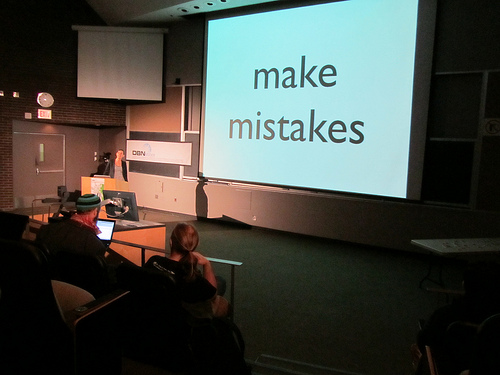
 Make Mistakes
Image: Mike Gifford via Flickr, CC 2.0

So what do we do?  Work on their self-confidence, teach them to be resilient to criticism, and remind them that mistakes are part (a very important part!) of the learning process.  I'm sure we all have a story or two about a horrible linguistic or cultural faux pas that we made while learning the language.  Personally, I mistakenly referred to New Year's good fortune (omikuji in Japanese) as a slug (namekuji in Japanese), horrifying and stupefying a Shinto priest in the process.  It doesn't help that slugs are pretty universally reviled in Japan.

Image: Everystockphoto.com

I personally share my stories of shame with my students so that they understand that mistakes happen to everyone.  One day even the most shameful mistakes (Embarazado, anyone?) are easy to look back on an laugh.  And laughter makes a good classroom tool, I think.

Here is a game that will get them talking and laughing.  Have the students work in pairs and have half of them turn their desks around facing the back of the classroom, while the other half face the front.  Give the students who are facing you a vocabulary word and then they must describe the word to their classmate using only Spanish.  I don't let them use hand gestures either.  Throw in a couple of non-vocabulary words too - just to keep them on their toes.


You can make it competitive by keeping score or you can keep it relaxed; you know your students and what will work best with them.  Mine love to compete so we make it a race to see which pair can come up with the correct word first.  In this activity they have to use their communication skills to talk - examples, descriptions, circumlocution - it's a beautiful thing!

Hasta pronto,

--AnneK

Thursday, August 29, 2013

Fin De Semana Largo


Amigos, I can't speak for you but I am really looking forward to this coming long weekend.  Not the way you normally look forward to a long weekend, but with the sort of desperate instability that comes from weeks of having fit too many responsibilities into too few hours in the day.

I'm stressed and I'm not handling it as well as I usually do . . . something about not having my daily work routine down yet.  Usually by week two or three I know exactly what needs to be done and when so that everything runs as it is supposed to, but my schedule this year just isn't conforming to my attempts to regulate it.  I feel like this cat . . .


I thought a long weekend picture might put a smile on my students' faces tomorrow, so I went online to find one.  I actually found quite a few, so I thought I would share them here.  These were all found in the wilds of the Internet and none of them are of my own making.


I do hate when people fail to use the opening exclamation mark.


 I also happened across a page or two of advertizements for excursions and hotels.  Here are a couple, just in case you want them as realia for a long weekend lesson.


And last but not least, a poster from what looks to be the worst movie ever.  I cannot imagine what educative purpose there could be for such a thing.  Maybe students can talk about what they don't want to do on their long weekend . . . or what the heck is depicted on this poster . . . or maybe what the plot of this movie could possibly be?  (Fun vocabulary: attack buzzard, crazed expression, faces aglow with radiation, talons of death . . . )


Have a great long weekend, mis amigos.  I hope you take advantage of every moment, and don't let the hovering vulture of doom get you.

Hasta pronto,

--AnneK

Wednesday, August 28, 2013

Circuíto de Aprendizaje

We had a big test in Spanish II yesterday and it was one of those things that you either got an A or an F on.  I wanted to go over it with the students but I knew that doing it in the large group would be a bore to most of them.  Furthermore, going over the test with the whole class invariably results in a lot of little questions that are best addressed one-on-one . . . so what to do?

It occurred to me this morning during 1st period planning actually.  I threw my lesson plan out the window and scurried around to put a new plan together at the last minute - learning stations!  This way I could work in small groups on test corrections while the other students were busy at various stations I put up around my room.


Station 1 - Test Corrections and Optional Extra Credit
Station 2 - Vocabulary Picture Drawing
Station 3 - Vocabulary Memory Matching Game
Station 4 - Listening Practice
Station 5 - Vocabulary Pantomime

As you can probably guess, we just learned some new vocabulary and it was time to start playing around with it.  But they weren't quite ready enough for me to turn them loose on some communicative practice without some scaffolding either, so the games, sketches, and pantomiming were a good choice.  And since listening is a receptive (as opposed to a productive) skill, it is also a good choice when first practicing with new vocabulary too.


So after we did a warmup activity and reviewed the vocabulary on Power Point, I introduced the stations and told the students to go stand at the station where they wanted to begin.  I kept the group maximum to four people since I am blessed with relatively small class sizes this year.  Then I started a timer on my iPad and I dove in to work with the group at the Test Corrections Station.

For those folks who had As on their tests and didn't need much help, I had an extra credit option and I also suggested that they might like to help a fellow student.  Some preferred working with others and some wanted to do extra credit, but all were amenable regardless.


All around the room students were engaged and learning - using their creative right brains to draw and act, and using their analytical left brains to play matching and to analyze the listening passages.  Honestly, what could be better?  I'm so glad I ditched the boring Let's-All-Review-The-Test-Together-Then-Make-Corrections plan!

Hasta pronto,

--AnneK

Sunday, August 25, 2013

Explorando El Vocabulario Con Los Sentidos

Getting the senses involved in learning makes a lot of sense and can be a lot of fun!  Recently my students had a vocabulary list with a lot of food items on it: naranja, limón, dátil, uvas, aceite, aceitunas, pipas, cidra, etc.  Someone suggested that we have a fiesta and sample all these foods, but I had a better idea.  Why not do more than just eat?  After all, the more senses you get involved, the more memorable the learning.


So I made a list and had the students sign up to bring in various foods.  I used Sign Up Genius, which is an amazing tool because it allows people to sign up online and sends them reminder emails.

I then put together a lesson that involved experiencing the vocabulary with all of the five senses.  We started by watching a little video with a song about the senses.  The video was for children but my high school students were not offended when I showed it to them.  Then students worked in groups and took turns trying to identify their vocabulary words with their sight (easy), smell, touch, taste, and hearing.  That last one was difficult but I had the students put food samples in a plastic cup and rattle it around so that they could hear a sound.  What sound does wheat bread make?  Not much, as it turns out.


I created an activity sheet to guide the students through the activity and help keep them focused and on task.  If you click the image below, it will link to the sheet so you can print it and use it in your classroom too if you would like.


 The beautiful thing was all the smiles and laughter I heard around the room as they participated in the activity.  They had a great time while they were learning and I had a great time just watching them!  I hope that your students have a good time doing this too.  It will really bring the food unit to life.

If you do decide to do this in your classroom, please drop me a line and let me know how it goes.  I'd love to hear from you.

Hasta pronto,

--AnneK


Thursday, August 22, 2013

Lo Estás Haciendo Mal . . .

You're doing it wrong.  It's a favorite meme and a gotcha with kids currently so, when I saw this picture, I couldn't resist.


I had a great summer vacation and I'm ready to get back to blogging and sharing with you now that August is waning . . . .  *sideways glance and nervous shuffling of feet*  Okay, so I actually teach at a year-round school and we're in Week 6. . . But who's counting, right? 

Honestly, the beginning of the year is such a pressure cooker that I didn't have much time to think about blogging and even less to actually do it.  Oh, and did I mention that the entire Blogspot.com domain is blocked at school currently?  *sad sigh*  This means that I won't be blogging from school, even after hours.

Hope is not lost though.  Our IT guy is a superhero and my principal actually listens to me . . . (It's true; don't be jealous.), so maybe we'll figure something out.

In the meantime, accept my good wishes for a great start to your school year and don't forget to leave comments and encouragement - not just on your students' papers, but also on the blogs you read. 

Hasta pronto,

--AnneK

Friday, May 31, 2013

Fotos Gratis de Alta Definición

If you are like me, you find yourself spending a lot of time online looking for royalty free photos and those under a creative commons license to use in your projects.  Honestly, I think I spend more time looking for images, requesting permission from photographers, and researching terms of use than any other thing I do.

So, with that in mind, it's with great joy I tell you about my latest find: morgueFile free photos.  They are high quality, high definition, and free to use - even in commercial products!  It is good manners to credit the photographers anyway, but it is not required.  The photos are honest-to-goodness free.


And there are a LOT of them too!  The above are some samples I found when I did a search on Spain.  (There were over 900 photos tagged with "Spain" by the way.)

I hope that morgueFile will be as useful to you as it is to me, amigos.  And have a great weekend!

Hasta pronto,

--AnneK

Thursday, May 30, 2013

Portavasos Con Mapas

I saw a DIY post on Pinterest today showing how to make coasters out of maps.  Personally, I'm not a coaster kind of girl.  My furniture is old, scarred up and shows the years of wear and tear that pets and kids have inflicted upon it - a moist drink is hardly going to make a difference.  Nor do I need coasters in my classroom . . . obviously.

Still, my teacher brain is telling me that I can use these coasters somehow.  For classroom use, I'm thinking they would have to be made with sturdy material that is not prone to breaking, so plastic would be good.  (I bet I can find plastic coasters at the dollar store.)

Then I would need to print maps of Spanish-speaking countries, maybe from Google Maps, and modpodge them onto the coasters.  Finally I would need to spray polyurethane or some other sealant on them to make them heavy duty for repeated classroom use.


Then what?  What to do with them?  How about . . .
  • Drawing one out at the beginning of class each day:  ¿Cuál es la capital de . . . . COSTA RICA? ¿En el mapa, dónde está . . . BOLIVIA?  ¿Cuáles países tienen frontera con . . . MÉXICO?  ¿En cuál continente está . . . ECUADOR?
  • Pairs Matching:  Los dos que tienen el mismo país trabajan en pareja.
  • Extra Credit Research: Del país seleccionado busca la siguiente información: un tribu indígena, el nombre del presidente actual, una artesanía típica, el plato más famoso, la bandera . . . 
  •  Game: Empareja los mapas y las banderas tan rápido como posible.  (Need to print flags, of course.)
Mind you, I realize that you don't need coasters in particular for any of the above activities - but the maps will help students to recognize where the countries are, the shape of their borders, the countries (and bodies of water) they border, and their capitals.  I think I might put this on my summer project list!

If you think of other map coaster ideas, please leave a comment.  I'm always looking for new ideas!

Hasta pronto,

--AnneK


Wednesday, May 29, 2013

Romeo y Julieta

Romeo and Juliet - a timeless love story . . . except this version has a definite time period.

I did not create the art myself, nor do I think the picture needs a caption.  It's funny on its own but I figured some Spanish I kids in 8th and 9th grade could probably use a nudge in the right direction so I put on the caption.  Plus, it's a good opportunity for them to use the context to guess the meaning of the word época, right?


I hope your students get a laugh out of it.  For that matter, I hope mine do too.  :-)

Hasta pronto,

--AnneK

Tuesday, May 28, 2013

GeoGuessr - Vamos A Explorar El Mundo

So, have you heard of GeoGuessr yet?  If not, it's just a matter of time.  My brother-in-law asked me for a quick lesson in Portuguese linguistics the other night and I gave him my suspicious face.   (Nobody EVER asks me to talk about linguistics on purpose.)  He needed to be able to distinguish written Portuguese from written Spanish.  Why?  He explained it was for an online game and I was suddenly very interested.

GeoGuessr is the new game that uses Google Street View panoramic photos and your own knowledge of geography.  When you start the game, you get a street view of an unknown spot in the world and you explore around until you feel comfortable making a guess at where in the world it might be.

Road signs, vegetation, and the landscape are the big clues.  Then you learn to look for little things like which side of the road the traffic is driving on, whether the signs are in metric or imperial measure, the language on advertisement on the sides of passing trucks, whether the ocean to the east or the west, etc.  A game of GeoGuessr lasts for five locations/guesses and will present you with a score and a map when you're finished.  The best score I've gotten so far was in the neighborhood of 13,500 - but I'll admit to a big bit of luck when I caught sight of a "Welcome to Utah" sign on that one!

Below is one that I did without benefit of welcome signs.  The score on this map was 12,300 . . . but of course, the idea isn't to get a high score so much as to explore the world and learn while you are doing it.  Still, I am so competitive that I can't help myself.  (Doggone it, Canada!  Why do you have to be so big?  LOL)


In short, it is a lot of fun and it is such an amazing learning tool.  So far the Google Van hasn't made it all over the Spanish-speaking world yet.  However, there are extensive maps of Spain and Mexico and a good start in Chile.  My head is spinning with ways this could be used in the classroom, but I'll let you explore it some for yourself and then I'll sprinkle my ideas in blog posts for the next couple days.

Enjoy yourselves, amigos.  Explore!

Hasta pronto,

--AnneK

Monday, May 27, 2013

Una Historia Fotográfica del Amor y Valor

Several weeks back I was looking for a story in pictures as a reference for my AP students to do an oral presentation, and I came across the story of Taylor Morris in the photography of Tim Dodd.  For those of you who might not be familiar with his story, Taylor Morris is a veteran and a hero.  He is a quadruple amputee as the result of surviving an explosion while deployed to Afghanistan.  But the pictures do not focus on war, instead they focus on the love that is shared between him and his wife - before and after the accident.

My students did a good job with their oral story-telling but I was thinking that, with some scaffolding, late Spanish II and early Spanish III students could do use the pictures to narrate in the preterite and imperfect.  However, having my students look online at photographs is one thing . . . making a lesson and publishing it online with copyrighted photography is quite another.  So I wrote to Tim Dodd and asked him if I could have permission to use his work in this lesson and he generously agreed.  So thanks for this lesson go in large part to his kindness.


The lesson is three and a half pages and features pictures in order that tell a story, vocabulary, writing instructions, and transitions.  At the end there are several extension activities that you might want to offer to students as well.  There is no specific discussion of preterite vs. imperfect on the sheet itself because I didn't want to turn it into a lengthy grammar lesson; I will leave that to your discretion as a teacher.  My personal plan is to use this at the culmination of our discussion on preterite and imperfect with an oral reminder as they begin the writing phase.

When I was in email contact with photographer Tim Dodd, he invited me to explore his website further and pointed me specifically to a story and a series of photos about a his friend Andy who has immigrated to the USA and has endured a great deal of hardship as the result of government mishandling of his paperwork.  I encourage everyone to read about it, just in case you know of someone or anything that can help.

Lastly, if I may just add, there is a great amount of discussion for and against when it comes to immigration, the conflict in Afghanistan, and other topics that are touched upon in this post.  I respect everyone's opinions but I do not wish for this work to become politically-charged.  If you wish to engage in anti-war or anti-American rhetoric, I humbly ask that you find another forum for that.

I hope the lesson is useful to you, amigos.  And may you all have a good Memorial Day.

Hasta Pronto,

--AnneK

Friday, May 24, 2013

Un Pensamiento Para Hoy

I cannot take credit for this image or for the idea behind it.  I saw the image by Risa Sin Más on Pinterest with the sentiment expressed in a comment.  It was a very profound comment that really made me sit back and think for a moment.  So I decided to caption it and repost it as a single image.


I think it would make a great starting point for a class discussion or even a resource for a writing prompt.  I know that Spanish IV talks about these sorts of issues and the new AP Spanish Language and Culture course has an entire strand called Global Challenges; this would tie into that perfectly.

I realize that solving world hunger is a very complicated matter that has to do with politics as much as it does with food, so I'm not trying to make a simplistic glib statement here.  I just believe the matter is worthy of thought.

With that, I hope everyone has a lovely weekend.

Hasta pronto,

--AnneK


Thursday, May 23, 2013

El Autismo Fotografiado Por Un Padre

I was over at BBC Mundo today looking for inspiration and I came across something unexpected.  There was this beautiful and thought-provoking slide show about autism.  The father of an autistic son has taken photos, originally as a way to make a connection with him.  Now he has published the photos in a book that will hopefully bring awareness and attention to autism, because it is a condition that makes people uncomfortable and is therefore difficult to understand.  The photos are both sad and lovely - and they do a remarkable job of highlighting those things that are different and those that are similar among children with autism and those without.


As teachers, we deal with autism more than most.  It can be very hard to work with a child who will never respond with affection or enthusiasm to what we teach, but those children need our attention and our talents as much as the others.  For me, as a "people person" I thrive on the positivity and excitement in my classroom and I work hard to draw out my shy students and build up their confidence.  But many autistic kids cannot be drawn out no matter what I do or how hard I try, and it makes me feel like a failure.  (Not accurate, I know.  But emotions are not concerned with accuracy or rationality.)

At home, my own kids are often all over me.  We will all pile up on the chaise together to watch TV, snuggle up, and enjoy each other's company.  I cannot imagine what it is like for parents when your child doesn't smile back at your or hug you.  It takes a special soul to raise a child with autism and I admire them.  I hope the rest of the world gives these parents the approval that they deserve for their dedication and abiding love, especially those with children who are unable to do so.  May we all keep that in mind when we have parent conferences.

Hasta pronto,

--AnneK

Wednesday, May 22, 2013

Rúbrica Para Actividades Orales

"We're tired of worksheets," they said.  I had given them a total of two over the past two days and I had thought that they were a good review as we approach final exams.  But there you have it - no more worksheets were wanted.

So we needed to review the dreaded preterite vs. imperfect today and worksheets were out of the question.  We did a little practice activity and corrected it in class.  Then I pulled a song out of the archives and we used it to discuss preterite, imperfect, and the uses of both.  (See this old post on the brilliant song, Tu falta de ortografía.)  But there are discussion questions on the sheet and I didn't want to assign them to be written (because that would make it a "worksheet"), and I knew that if we did them as a discussion in the large group that not everyone would participate.

So I assigned the questions as an oral activity.  Students were given some time to prepare their answers and then I called them to my desk individually and asked them one of the three questions at random.  They were told that they would not be allowed to read their response.  They had to speak from memory.  I graded them with a super simple speaking rubric which I'm sharing with you here today.


This is a good activity because students prepare answers to all three questions and when they know they are being graded on their vocabulary, pronunciation, thoroughness, and grammar, they really go out of their way to prepare good responses.  The discussions I heard around the room made my heart all warm and fluttery in a good way.  (Is that ser or estar?  Don't forget to make it feminine.  No, you say it like this . . . because there is an accent mark on it.  Etc.)

Now here is where it becomes fun.  I let them roll dice to figure out which prompt they would have to answer.  Then somehow a classroom miracle occurred.  The oral response inexplicably turned into a game.  When it was their turn, a student would come up, take the die, go through their own personal good luck rituals, and roll.  Applause would erupt if they got the number they were hoping for (or the 6 - which allowed them to select the prompt they wanted).  They cheered for each other and they had an absolute blast with it!  Honestly.  I have never seen kids so excited by a speaking activity in my life and it made me soooo glad that I didn't give them another written review sheet!

The rubric is simple and easy to use.  There is a grading key at the bottom of it which sets a high standard for an A - but makes a B or a C very obtainable.  D and F grades really only apply to those students who are not making an effort.  This, in my opinion, is how it should be.

Two rubrics fit on one sheet of paper so you can cut the sheet in half and save copies.  And, because I teach so many different levels, I have a copy of the rubric in Spanish and one in English.  I'm sharing it with you today in the hopes that you can get your students speaking and that it might be of some use to you.  Have fun with it!

Hasta pronto,

--AnneK

Tuesday, May 21, 2013

Merzco Las Vacaciones

La verdad es que no tengo mucho que decir hoy.  Hubo un sinfin de locuras y tonterías hoy y llego a la hora de dormir ya lista de acostarme para poder empezar de nuevo mañana.

Pero ya tengo muchos días consecutivos con actualizaciones aquí y no quiero poner fin a lo que he logrado.

Porque no tengo energía para inventar algo en este momento y tampoco tengo algo especialmente ingenioso ya hecho para compartir, voy a compartir algo que me hizo reír hoy.


Esto dedico a mis amigos que se quejan de mis vacaciones (incluso mi suegro que una vez me preguntó si me gustaba trabajar a tiempo parcial . . .).  Estoy completamente segura de que trabajo más horas que mis amigos. No cabe duda.

Ojalá que mañana traiga inspiración y paz interior . . . y algo para compartir con ustedes aquí.  :-)

Hasta pronto,

--AnneK

Monday, May 20, 2013

Pretérito e Imperfecto: Expresiones

We are in the last couple of days of Spanish II in my 6th period and, as always, the preterite and the imperfect is the scariest part of the final exam that looms ahead in a mere matter of days.  (For that matter, it might still be the scariest part of the final exam for some of my Spanish III students.) 

One of the tools I use to teach the difference between preterite and imperfect are the expressions that are commonly associated with each tense.  Expressions like generalmente, a veces, and siempre are usually followed by imperfect.  But expressions like una vez, de repente, and en seguida are usually followed by the preterite. 

I made a set of flashcards with some of the expressions.  One set in English and one set in Spanish.  They can use the cards to play Memory; they can draw them out of a bin and use them in a sentence; they can write the meanings on the back and study them . . . the uses are endless!


I'm sharing the file with you.  You can print them on heavy card stock and cut them out, or you could distribute them to your students and have them make the flashcards.  Whatever you like.  I went over the expressions with them ahead of time and we discussed in the large group why each one was associated with preterite or imperfect.  Then they took some notes and did some practice activities.  Overall, I saw a big improvement on the last Spanish II test - so it seems to be working.

It is not perfect.  I probably left off some important expressions and the ones I included might not be ones that you would choose.  Additionally, I can think of some examples where a speaker might say something that did not follow the paradigm like, "Una vez yo estaba en la cocina de mi abuela cuando vi un ratón."  That sentence is not incorrect - it just wasn't made for Spanish II students.

Though native speakers might not be so forgiving, I tend to be fairly direct with my final exams.  If it's a preterite expression, I'll have a verb that needs preterite.  I'm not going to switch it up on them and surprise them with an imperfect verb following a preterite expression - that would just be mean and wrong on so many levels.  (If they go on to study the language in more depth and deal with native speakers, they will learn the exceptions to the rules then.)

I hope you find these flashcards useful and may your Monday go by happily!

Hasta pronto,

--AnneK