I put together a year-end review for my Spanish II students. They have their final exams coming up later this week and next week. I wanted to make sure they have all the topics in one place so that they know what to study.
I did not link most of the vocabulary topics because the students have access to them in Dropbox, but I found links to online practice activities for many of the grammar topics on Quia.
Since every Spanish II course is a little bit different from the next, I doubt the document will be of extensive use to you as it is. But the list of topics, the links to online practice, and the speaking/writing prompts might be of some use. Feel free to take it, look it over, and build upon it to meet your own needs. I am putting this up in an editable Doc format so that you can use it and make changes to reflect your own vocabulary topics, grammar topics, and speaking/writing prompts.
Click the image above or click here to download the file.
I am not teaching Spanish 1 or 3 this year, so I haven't made study guides for them. Maybe next year!
Hasta pronto, amigos.
--AnneK
A resource for Spanish teachers everywhere. These are my own reflections on my practice, my experiences, and things that I have created and want to share.
Monday, May 26, 2014
Sunday, May 25, 2014
An Explanation of WEIRDO Verbs
Years ago in Spanish class I learned subjunctive in the same grueling way that people before me had learned - with long and complicated rules that made little sense to me and that seemed incomprehensible.
"The subjunctive mood occurs with a change of subject in subordinate clauses and requires the the employment of a verb of volition, negation, or doubt in the main clause."
It is no wonder everyone thought the subjunctive so hard! Rules like the above make it nearly impossible to understand.
Years ago I came across the acronym WEIRDO that was used to describe which sorts of verbs would trigger the subjunctive in the subordinate clause. It was like a breath of fresh air and I suddenly had a cute little way of laying out the rules for the subjunctive to my students.
But I have a lot of teachers write to me and tell me they don't know what I mean by "weirdo verbs" or that they would like to have a way of presenting this material to their students. Yesterday Michelle, a reader of this blog, wrote and asked how to teach weirdo verbs to her students. So I got to thinking about it and decided to make a Power Point that we can use to show to our students and help them make sense of the subjunctive.
I had a great time making this slide show, creating the background images, animating my little weirdo monster and playing around with various colors and effects. I think your students will find it memorable and I hope it will help them to understand the mechanics of the subjunctive a bit better. Click the image above or click here to download the Power Point.
I would love to hear from you if you find it useful, amigos.
Hasta pronto,
--AnneK
"The subjunctive mood occurs with a change of subject in subordinate clauses and requires the the employment of a verb of volition, negation, or doubt in the main clause."
It is no wonder everyone thought the subjunctive so hard! Rules like the above make it nearly impossible to understand.
Years ago I came across the acronym WEIRDO that was used to describe which sorts of verbs would trigger the subjunctive in the subordinate clause. It was like a breath of fresh air and I suddenly had a cute little way of laying out the rules for the subjunctive to my students.
But I have a lot of teachers write to me and tell me they don't know what I mean by "weirdo verbs" or that they would like to have a way of presenting this material to their students. Yesterday Michelle, a reader of this blog, wrote and asked how to teach weirdo verbs to her students. So I got to thinking about it and decided to make a Power Point that we can use to show to our students and help them make sense of the subjunctive.
I had a great time making this slide show, creating the background images, animating my little weirdo monster and playing around with various colors and effects. I think your students will find it memorable and I hope it will help them to understand the mechanics of the subjunctive a bit better. Click the image above or click here to download the Power Point.
I would love to hear from you if you find it useful, amigos.
Hasta pronto,
--AnneK
Friday, May 23, 2014
Haber y los Tiempos Compuestos
Who doesn't have a hard time with the perfect tenses?! At least at first, they can be very confusing, especially to those students who might not have a strong grip on their own language. I often find that students are unable to distinguish between "have verbed" and "had verbed" in English, and that makes explaining it in Spanish even more difficult.
Using the perfect tenses may be quite difficult, but forming them really isn't necessarily very hard. The participles are fairly straightforward and there are just a few forms of haber to learn. Even so, it is nice to have everything organized and in one spot for studying purposes.
As I look closer at the image now, I see that one of my students is confused about which forms of haber go where, so do not use this one as an example. I will track her down and help her make corrections early next week. One does not want to be studying the wrong thing after all.
If you want the template to use in your classes, you can click the image above or you can click here to download it.
As always, it would be great to hear from you if you find something useful here. Its great to connect with my fellow Spanish teachers in the world.
Hasta pronto,
--AnneK
Thursday, May 22, 2014
Y El Tiempo Pasa . . .
Where does the time go? I have all these blog posts I want to put up but I keep coming home and crashing instead of blogging. There are solid biological reasons for my behavior, yes. But it's a shame that I haven't found time for this blog lately.
Let me start the backlog of lost posts with el Día de las Madres. (A little late, I know.) Students of mine were testing and my classes were only half full, so it was one of those days when you feel like you can't introduce new material, you can't do anything super meaningful, and you certainly can't do an assessment.
So I had them working on a little Mother's Day activity in grupitos and, when they had a chance, they were each to get a picture of themselves as a gift for their mother. Here are some of them for you to enjoy.
I took construction paper and made the back drop in the morning before school. Then, as a group, we came up with some ideas about what we wanted to say to our mothers. Each person was able to write their own personalized message, but it had to be in Spanish.
I got a lot of nice feedback from the moms and a lot of stories from the kids about how they got to teach their mothers a bit of Spanish.
Hasta pronto,
--AnneK
Let me start the backlog of lost posts with el Día de las Madres. (A little late, I know.) Students of mine were testing and my classes were only half full, so it was one of those days when you feel like you can't introduce new material, you can't do anything super meaningful, and you certainly can't do an assessment.
So I had them working on a little Mother's Day activity in grupitos and, when they had a chance, they were each to get a picture of themselves as a gift for their mother. Here are some of them for you to enjoy.
I took construction paper and made the back drop in the morning before school. Then, as a group, we came up with some ideas about what we wanted to say to our mothers. Each person was able to write their own personalized message, but it had to be in Spanish.
I got a lot of nice feedback from the moms and a lot of stories from the kids about how they got to teach their mothers a bit of Spanish.
Hasta pronto,
--AnneK
Thursday, April 10, 2014
Cómo Hacer Una Prueba Oral
Sometimes I get bogged down in "covering material x" and I lose sight of what it is I'm supposed to be doing - teaching the beautiful Spanish language. I'm betting that there are people out there that know what I mean. It's not about covering the present perfect subjunctive and 5A vocabulary so much as it is giving students meaningful practice so that they can communicate in the language.
It occurred to me late last week that I need to do some more oral practice with my students and, at least in my case, to get that to happen they have to know that there is going to be an assessment to follow. I decided that an oral quiz was in order.
I don't know how you do oral quizzes but I've always struggled with them. Ultimately it would be great if I had coverage so that I could put a table out in the hall and meet with one student at a time in relative privacy and peace. I don't have coverage and I hate to impose on my colleagues, so I have to come up with another approach. Our French teacher has the students record their voices using an app on their iPads - and this is good. But that measures pronunciation, not communication or fluency - because students will write themselves a script and just read it. So what to do?
I give the class an activity to work on and I encourage them to work together with their friends completing it. (Yesterday it happened to be a whoppin' big vocabulary crossword puzzles with clues in Spanish. I made it myself and I'm quite proud of it actually.) This gets them thinking in Spanish about the vocabulary and, as they work the volume in the room goes up a little. Then I turn on the radio in the background and the volume in the room goes up a little more. While all of that is going on, I begin to call students to my desk one at a time to do the oral quiz. We get our one-on-one time and, with the white noise and the distraction of the group work going on in the background, it's surprisingly private. I try to put students at ease by making friendly small talk before we get started and by offering a piece of candy from the candy bin when they are finished.
I think there is a special power in oral quizzes, but not for the communicative and linguistic reasons you might be thinking. I honestly think any discipline could benefit from the one-on-one oral quiz format because I notice that when I do this the motivation of my students goes way up. I theorize that it is due to the face-to-face nature of the quiz. It is one thing to fail a quiz on paper in an impersonal way, but it is quite another to fail a quiz up close and personal while looking your teacher in the face.
My 4th period were so motivated that they formed little study groups and gave the oral prompts to one another over and over again to support and help each other practice. They also did an outstanding job on the quiz, so clearly they are on to something.
Giveaway Update: I've had several comments from people who are interested in receiving a free copy of my Earth Day Communication lesson. But there are two (actually three, if you want to be technical) things you must do to win the free lesson plan: 1) Subscribe to the blog, 2) Leave me a comment saying you want a copy before April 22 and 3) Send me an email address so I can send you the download link. I'm not going to keep your email on file, share it with anyone, or send you any unwanted email whatsoever. That is my solemn promise. I just need a place to send the link so you can download it.
So far only one person has done this, so I still have at least four copies to give away.
Hasta pronto amigos,
--AnneK
It occurred to me late last week that I need to do some more oral practice with my students and, at least in my case, to get that to happen they have to know that there is going to be an assessment to follow. I decided that an oral quiz was in order.
I don't know how you do oral quizzes but I've always struggled with them. Ultimately it would be great if I had coverage so that I could put a table out in the hall and meet with one student at a time in relative privacy and peace. I don't have coverage and I hate to impose on my colleagues, so I have to come up with another approach. Our French teacher has the students record their voices using an app on their iPads - and this is good. But that measures pronunciation, not communication or fluency - because students will write themselves a script and just read it. So what to do?
I give the class an activity to work on and I encourage them to work together with their friends completing it. (Yesterday it happened to be a whoppin' big vocabulary crossword puzzles with clues in Spanish. I made it myself and I'm quite proud of it actually.) This gets them thinking in Spanish about the vocabulary and, as they work the volume in the room goes up a little. Then I turn on the radio in the background and the volume in the room goes up a little more. While all of that is going on, I begin to call students to my desk one at a time to do the oral quiz. We get our one-on-one time and, with the white noise and the distraction of the group work going on in the background, it's surprisingly private. I try to put students at ease by making friendly small talk before we get started and by offering a piece of candy from the candy bin when they are finished.
I think there is a special power in oral quizzes, but not for the communicative and linguistic reasons you might be thinking. I honestly think any discipline could benefit from the one-on-one oral quiz format because I notice that when I do this the motivation of my students goes way up. I theorize that it is due to the face-to-face nature of the quiz. It is one thing to fail a quiz on paper in an impersonal way, but it is quite another to fail a quiz up close and personal while looking your teacher in the face.
My 4th period were so motivated that they formed little study groups and gave the oral prompts to one another over and over again to support and help each other practice. They also did an outstanding job on the quiz, so clearly they are on to something.
Giveaway Update: I've had several comments from people who are interested in receiving a free copy of my Earth Day Communication lesson. But there are two (actually three, if you want to be technical) things you must do to win the free lesson plan: 1) Subscribe to the blog, 2) Leave me a comment saying you want a copy before April 22 and 3) Send me an email address so I can send you the download link. I'm not going to keep your email on file, share it with anyone, or send you any unwanted email whatsoever. That is my solemn promise. I just need a place to send the link so you can download it.
So far only one person has done this, so I still have at least four copies to give away.
Hasta pronto amigos,
--AnneK
Monday, April 7, 2014
Shameless Self Promotion and a Giveaway!!
Amigos,
I have been focused lately on creating scaffolded conversation lessons. The idea is to give students something culturally relevant (a picture, a piece of realia, a video clip, etc) along with some vocabulary and let them use their Spanish skills to describe it. Then I provide a sample dialog that is on the same topic to practice their pronunciation. The next step is key: the students then take the dialog and replace certain key words with others to create an original dialog on the same topic. This gives them the support they need instead of just turning them loose with a vocabulary list and saying "Write a dialog in Spanish on this topic and be sure to use at least ten vocabulary words in it." (Haven't we all been there at least once?)
The fun comes when they replace the words in the dialog with something funny or clever. I had a pair in Spanish IV last Friday come up with the expression, "No puedo aguantar tu cara ni un minuto más." That cracked me up and I literally burst into raucous laughter, which made class so much more fun than if I had just given them the "Write a dialog . . . " routine.
Over my spring break I told myself that I was going to create some new lessons for my Teachers Pay Teachers portfolio. (I'm trying to save up some money to attend the ACTFL conference and that isn't going to happen if I don't produce some great materials for people to purchase.) But I was plagued with strep throat and spent much of my two weeks just feeling miserable instead of being creative. But I decided to remedy the situation yesterday by creating a conversation lesson, like the one I mentioned above, on the topic of Earth Day.
For a mere $2.50 you can get your students talking in Spanish about the Earth, the environment, and being responsible caretakers for our planet. And here's the best part: I created three different versions of the lesson so that you can use it with your Spanish 1, Spanish 2, and your Spanish 3 students! And, who knows, they might surprise you and come up with something that thrills and delights you in the process!
I don't have many followers here on this blog, a mere 20 of you for whom I am very thankful. So I've decided to do a membership drive and a giveaway. Between now and Earth Day (April 22) I will give this product away to five -or more- members who leave a comment below. You need to be listed to the right as a follower of the blog and let me know who you are in the comments field. Since I don't get much traffic through here, I might not get to give all five copies away but here's to hoping!
Have a brilliant Monday, amigos. I hope to hear from you soon!
Hasta pronto,
--AnneK
I have been focused lately on creating scaffolded conversation lessons. The idea is to give students something culturally relevant (a picture, a piece of realia, a video clip, etc) along with some vocabulary and let them use their Spanish skills to describe it. Then I provide a sample dialog that is on the same topic to practice their pronunciation. The next step is key: the students then take the dialog and replace certain key words with others to create an original dialog on the same topic. This gives them the support they need instead of just turning them loose with a vocabulary list and saying "Write a dialog in Spanish on this topic and be sure to use at least ten vocabulary words in it." (Haven't we all been there at least once?)
The fun comes when they replace the words in the dialog with something funny or clever. I had a pair in Spanish IV last Friday come up with the expression, "No puedo aguantar tu cara ni un minuto más." That cracked me up and I literally burst into raucous laughter, which made class so much more fun than if I had just given them the "Write a dialog . . . " routine.
Over my spring break I told myself that I was going to create some new lessons for my Teachers Pay Teachers portfolio. (I'm trying to save up some money to attend the ACTFL conference and that isn't going to happen if I don't produce some great materials for people to purchase.) But I was plagued with strep throat and spent much of my two weeks just feeling miserable instead of being creative. But I decided to remedy the situation yesterday by creating a conversation lesson, like the one I mentioned above, on the topic of Earth Day.
For a mere $2.50 you can get your students talking in Spanish about the Earth, the environment, and being responsible caretakers for our planet. And here's the best part: I created three different versions of the lesson so that you can use it with your Spanish 1, Spanish 2, and your Spanish 3 students! And, who knows, they might surprise you and come up with something that thrills and delights you in the process!
I don't have many followers here on this blog, a mere 20 of you for whom I am very thankful. So I've decided to do a membership drive and a giveaway. Between now and Earth Day (April 22) I will give this product away to five -or more- members who leave a comment below. You need to be listed to the right as a follower of the blog and let me know who you are in the comments field. Since I don't get much traffic through here, I might not get to give all five copies away but here's to hoping!
Have a brilliant Monday, amigos. I hope to hear from you soon!
Hasta pronto,
--AnneK
Saturday, April 5, 2014
"Craftividad" Pintar Una Camiseta
¡Hola amigos!
I came across this adorable little "craftivity" today over at Zambombazo (which is a fabulous blog filled with activities and ideas for Spanish teachers).
Since my theme this year is "Unleash Your Superhero" I figured this would be a great thing to share here. And the best part is that the instructional video is entirely in Spanish!
I don't think I'd make the design by tracing the image on the screen like the video shows. I think a better way would be to print the image and work from the print, but I'm not going to quibble or micromanage. There are a lot of ways to do any given task.
This would be a great extra credit project to give students. Make it clear that they have to watch the video and follow the instructions en español.
Es todo por hoy, amigos. ¡Que tengan un lindo fin de semana!
--AnneK
I came across this adorable little "craftivity" today over at Zambombazo (which is a fabulous blog filled with activities and ideas for Spanish teachers).
Since my theme this year is "Unleash Your Superhero" I figured this would be a great thing to share here. And the best part is that the instructional video is entirely in Spanish!
I don't think I'd make the design by tracing the image on the screen like the video shows. I think a better way would be to print the image and work from the print, but I'm not going to quibble or micromanage. There are a lot of ways to do any given task.
This would be a great extra credit project to give students. Make it clear that they have to watch the video and follow the instructions en español.
Es todo por hoy, amigos. ¡Que tengan un lindo fin de semana!
--AnneK
Thursday, April 3, 2014
¡Me Quedo Muy Retrasada!
I'm so far behind, amigos. I don't know exactly how it happens . . . one day, I'm going along just fine and doing what I'm supposed to do . . . then I turn around and all my laundry is dirty, the projects haven't been graded, there is nothing in the fridge, and I haven't blogged in over a month.
I'm not sure what has slowed me down - the bad weather (despite my premature declaration of spring), a bout with strep throat, and it seems as though some weeks all I do is drive my teenage daughter from one activity to another . . . but I apologize for being gone so long. I do have some good things to share here and, hopefully, I'll get back on board the blog train.
Today I came across some funny photos and it occurred to me that they would make great conversation prompts. These are probably best for your intermediate students as beginners would likely be completely stymied.
The topic of the photos is bad design, and you can't help but laugh at some of them!
Here are some activities that occurred to me, but there are plenty of others I'm sure you can think of too.
1. Make comparisons - Malo, peor, el peor
2. Use the conditional tense - ¿Qué pasaría al usar esta cuchara?
3. Describe the problem - La silla sería muy incómoda . . . El agua no podría salir de la regadera.
4. Think creatively! Is there anything you could do with the object? Se podría usar el vaso para las flores. El botón podría ser un pisapapeles.
5. For fun, get students to design their own bad objects and describe them to each other in Spanish.
And that's it for me today, amigos. I'll try to make a regular appearance until the end of the school year.
Hasta pronto,
--AnneK
I'm not sure what has slowed me down - the bad weather (despite my premature declaration of spring), a bout with strep throat, and it seems as though some weeks all I do is drive my teenage daughter from one activity to another . . . but I apologize for being gone so long. I do have some good things to share here and, hopefully, I'll get back on board the blog train.
Today I came across some funny photos and it occurred to me that they would make great conversation prompts. These are probably best for your intermediate students as beginners would likely be completely stymied.
The topic of the photos is bad design, and you can't help but laugh at some of them!
Here are some activities that occurred to me, but there are plenty of others I'm sure you can think of too.
1. Make comparisons - Malo, peor, el peor
2. Use the conditional tense - ¿Qué pasaría al usar esta cuchara?
3. Describe the problem - La silla sería muy incómoda . . . El agua no podría salir de la regadera.
4. Think creatively! Is there anything you could do with the object? Se podría usar el vaso para las flores. El botón podría ser un pisapapeles.
5. For fun, get students to design their own bad objects and describe them to each other in Spanish.
And that's it for me today, amigos. I'll try to make a regular appearance until the end of the school year.
Hasta pronto,
--AnneK
Sunday, March 2, 2014
¡Que Llegue La Primavera!
¡Saludos calurosos, amigos!
Winter is the season of my soul's discontent. I do my best to hold on and stay positive through the winter but ultimately, no matter what I seem to do, I wind up feeling down in the dumps. I go through a miniature depression every year between Christmas and March 1st.
Regardless of the weather, I declare it spring on March 1st. I know I'm off by about three weeks officially, but I can't stand it a moment longer so I don't. As far as I'm concerned, it's officially spring. You are welcome to disagree, but you will not sway me. In this I am firm.
I spent the afternoon looking up springtime quotes in Spanish, and picking out photographs from Clipart.com to go along with them. Then I put them together in little graphics that I can use in my lessons. Some have subjunctive, others have command forms, yet others have future tense. And some are very basic and won't frighten off even the most timid beginners.
I'm sharing them here with you today. Even if you still have a foot of snow outside, hope is here.
Les mando abrazos calientitos . . .
--AnneK
Winter is the season of my soul's discontent. I do my best to hold on and stay positive through the winter but ultimately, no matter what I seem to do, I wind up feeling down in the dumps. I go through a miniature depression every year between Christmas and March 1st.
Regardless of the weather, I declare it spring on March 1st. I know I'm off by about three weeks officially, but I can't stand it a moment longer so I don't. As far as I'm concerned, it's officially spring. You are welcome to disagree, but you will not sway me. In this I am firm.
I spent the afternoon looking up springtime quotes in Spanish, and picking out photographs from Clipart.com to go along with them. Then I put them together in little graphics that I can use in my lessons. Some have subjunctive, others have command forms, yet others have future tense. And some are very basic and won't frighten off even the most timid beginners.
I'm sharing them here with you today. Even if you still have a foot of snow outside, hope is here.
Les mando abrazos calientitos . . .
--AnneK
Thursday, February 27, 2014
Descuento de 20%
There is a big sale going on today and tomorrow (February 27-28) at Teachers Pay Teachers and I'm taking part. Everything in my store will be on sale at a discounted 20% off - including my brand new Weather Mini Unit with Geography, Science, and Math Connections.
If you've ever downloaded something of mine here for free and you found yourself feeling grateful and appreciative, please do me the honor of stopping by my store to see what I have for sale. I put all my love into my products and create the kinds of things that I can feel proud of and can use in my own classes. So I sincerely believe that anything of mine you buy there will serve you well for years to come.
The money I get from TPT goes into a special travel fund so that I can attend conferences. I was hoping to go to Panama City this summer to attend the national AATSP conference. I would so love to see the Panama Canal and take pictures of all kinds of things to share online, but I'm going to be shy of my goal. But that's okay! I'm not going to get gloomy about it or anything. I'll keep saving for next year and who knows! But every little bitty bit helps, so know that I am grateful for anything you purchase.
Hasta pronto, amigos.
--AnneK
Tuesday, February 25, 2014
El Imperfecto del Subjuntivo
It never ceases to amaze me how quickly students in Spanish IV learn new conjugations. I mean, in comparison to the introduction of conjugation in Spanish I and the present tense and, heaven help us, the crucible that is the preterite in Spanish II, the other tenses just seem to come easier. Even when I stood up yesterday and announced that there was (gasp!) another subjunctive tense and we would be learning it, no one batted an eye.
It helps that the imperfect subjunctive technically has no irregular verbs and that students already know when to use the subjunctive by the time it rolls around.
What didn't help was that there were no fun activities to be found online. I wanted puzzles, pictures, skits, you know . . . but I guess that producers of educational materials figure if you've made it this far into Spanish then you must be mature. That is mostly true, but it does not mean that we don't want to have fun.
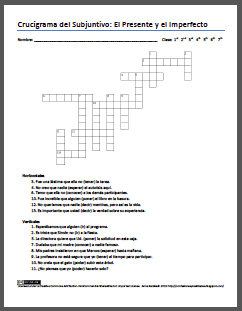
I didn't have time today to come up with a rip-roaring, hooting-tooting board game - sadly. But I did have enough time to create a crossword puzzle. You can click here to download it or click on the image above. This particular crossword focuses on when to use the present subjunctive and when to use the imperfect subjunctive. My students literally just learned the tense yesterday and were ready for this today, so you can plan to do it very shortly after you introduce the tense. I included all the trouble verbs: poder/poner, decir/dar, ir/ver, hacer, querer, etc. You know, the usual suspects.
Obviously, a topic this advanced is going to be for a Spanish IV or V class or an especially gifted Spanish III group. You might want to throw it in as a quick grammar review for AP, though I admit that it has nothing to do with any of the AP Themes.
Oh! I made an answer key too. Click here for a copy of the answers.
I hope yours is a great day, amigos!
Hasta Pronto,
--AnneK
It helps that the imperfect subjunctive technically has no irregular verbs and that students already know when to use the subjunctive by the time it rolls around.
What didn't help was that there were no fun activities to be found online. I wanted puzzles, pictures, skits, you know . . . but I guess that producers of educational materials figure if you've made it this far into Spanish then you must be mature. That is mostly true, but it does not mean that we don't want to have fun.
I didn't have time today to come up with a rip-roaring, hooting-tooting board game - sadly. But I did have enough time to create a crossword puzzle. You can click here to download it or click on the image above. This particular crossword focuses on when to use the present subjunctive and when to use the imperfect subjunctive. My students literally just learned the tense yesterday and were ready for this today, so you can plan to do it very shortly after you introduce the tense. I included all the trouble verbs: poder/poner, decir/dar, ir/ver, hacer, querer, etc. You know, the usual suspects.
Obviously, a topic this advanced is going to be for a Spanish IV or V class or an especially gifted Spanish III group. You might want to throw it in as a quick grammar review for AP, though I admit that it has nothing to do with any of the AP Themes.
Oh! I made an answer key too. Click here for a copy of the answers.
I hope yours is a great day, amigos!
Hasta Pronto,
--AnneK
Tuesday, February 18, 2014
Expresiones Con Tener
Oh those expressions with tener! The concept of idiomatic expressions is difficult for many language learners. I recall being a middle schooler myself and being shocked when I first learned that one could not simply translate things word for word in the exact order. It was an eye-opener!
However, in my experience, most students can get their heads around wildly imaginative words and phrases being different from language to language. They generally don't expect unusual phrases to be direct translations.
It's raining to beat the band. ( ≠ Lovía para derrotar a la banda.)
She looked like death warmed over. ( ≠ Se veía como la muerte recalentada.)
That's my two cents. ( ≠ Son mis dos centavos.)
It came out of the clear blue. ( ≠ Vino del azul claro.)
Sometimes though, I find that it is even more difficult for students to get the concept of idiomatic expressions that are close. I think I might have to be hauled off to an asylum if I hear "tener divertido" one more time. Ja ja ja.
The expressions with tener are one of those things that are perennial problems for my students and I don't think most textbooks give them enough time and attention. I think a lot of fun activities can be done with these expressions like charades, drawings, skits. But as a review I put together a brief Power Point with clip art.
I do not own the license to any of the clip art in the file. It is used here simply for educational purposes.
Click here to download the file, or click on the picture above.
As always, it would be great to hear from you if you download the file or use it in your class.
Hasta pronto,
--AnneK
However, in my experience, most students can get their heads around wildly imaginative words and phrases being different from language to language. They generally don't expect unusual phrases to be direct translations.
It's raining to beat the band. ( ≠ Lovía para derrotar a la banda.)
She looked like death warmed over. ( ≠ Se veía como la muerte recalentada.)
That's my two cents. ( ≠ Son mis dos centavos.)
It came out of the clear blue. ( ≠ Vino del azul claro.)
Sometimes though, I find that it is even more difficult for students to get the concept of idiomatic expressions that are close. I think I might have to be hauled off to an asylum if I hear "tener divertido" one more time. Ja ja ja.
The expressions with tener are one of those things that are perennial problems for my students and I don't think most textbooks give them enough time and attention. I think a lot of fun activities can be done with these expressions like charades, drawings, skits. But as a review I put together a brief Power Point with clip art.
I do not own the license to any of the clip art in the file. It is used here simply for educational purposes.
Click here to download the file, or click on the picture above.
As always, it would be great to hear from you if you download the file or use it in your class.
Hasta pronto,
--AnneK
Monday, February 10, 2014
Si Los Besos Fueran Agua . . .
. . . yo te daría un mar.
Hi again, amigos. I've been taking a break from blogging for a bit because I've been dealing with some personal issues, but I'm ready to poke y head back in here, at least for today, and share some work.
Two of the classes I teach this semester (Spanish IV and AP Spanish) are fairly advanced for high school and I'm often discovering that there is a lack of good material available online to supplement my lessons. To that end, I create a lot of my own material and I thought I might share some with you here today.
This lesson is intended as a review to students who have already learned the conditional tense and the imperfect subjunctive. (Advanced, as I was saying.) I am fortunate to have such high achievers in my 5th, 6th, and 7th period classes so I put this little review and practice activities together for us to go over in classes as we go into the dreaded "Sequence of Tenses." It focuses on the use of imperfect subjunctive to express unreal situations and the conditional to discuss what one would do under those circumstances.
On the sheet there is a link to a really weird video - really weird, that gives and example of the two tenses used together. You might want to take a look at it before you share it with your classes - just to prepare yourself.
I hope the lesson is useful to you, amigos! Click on the image above or click here to download the activity.
Hasta pronto,
--AnneK
Hi again, amigos. I've been taking a break from blogging for a bit because I've been dealing with some personal issues, but I'm ready to poke y head back in here, at least for today, and share some work.
Two of the classes I teach this semester (Spanish IV and AP Spanish) are fairly advanced for high school and I'm often discovering that there is a lack of good material available online to supplement my lessons. To that end, I create a lot of my own material and I thought I might share some with you here today.
This lesson is intended as a review to students who have already learned the conditional tense and the imperfect subjunctive. (Advanced, as I was saying.) I am fortunate to have such high achievers in my 5th, 6th, and 7th period classes so I put this little review and practice activities together for us to go over in classes as we go into the dreaded "Sequence of Tenses." It focuses on the use of imperfect subjunctive to express unreal situations and the conditional to discuss what one would do under those circumstances.
On the sheet there is a link to a really weird video - really weird, that gives and example of the two tenses used together. You might want to take a look at it before you share it with your classes - just to prepare yourself.
I hope the lesson is useful to you, amigos! Click on the image above or click here to download the activity.
Hasta pronto,
--AnneK
Thursday, January 23, 2014
Luddy Outcome: Problem Solving
In my classroom we have been
focusing on the Luddy Outcome of problem solving lately, but the trick
is to work these Luddy Outcomes into my lesson plans in a way that
supports the curriculum. Most of the time that is easy enough to do
because I can just discuss the issue in Spanish, but it is not ideal
because I always have to wonder how much of what I'm explaining is
really getting through.
I am always questing for ways to work these things into my lessons in creative, fun, and Spanish ways. Spanish II is reviewing food vocabulary and preterite tense right now so it occurs to me that it might be fun to create a logic puzzle in Spanish that uses our vocabulary. I also threw in ordinal numbers because my students never seem to ever really learn them.
Cuatro niños (Gabriela, María, Ignacio y Simón) ayudan a su abuela hacer una sopa. Cada uno trajo un ingrediente diferente (carne, sal, zanahorias, y papas). ¿Quién trajo cada ingrediente y en qué orden los pusieron en la sopa?
The puzzle is not especially difficult. The tricky part (for the students) is understanding it in Spanish.
I've posted the answer below, but it's in white so you can't see it. Highlight it to reveal it.
Hasta pronto,
--AnneK
I am always questing for ways to work these things into my lessons in creative, fun, and Spanish ways. Spanish II is reviewing food vocabulary and preterite tense right now so it occurs to me that it might be fun to create a logic puzzle in Spanish that uses our vocabulary. I also threw in ordinal numbers because my students never seem to ever really learn them.
Cuatro niños (Gabriela, María, Ignacio y Simón) ayudan a su abuela hacer una sopa. Cada uno trajo un ingrediente diferente (carne, sal, zanahorias, y papas). ¿Quién trajo cada ingrediente y en qué orden los pusieron en la sopa?
1)
Las niñas trajeron verduras.
2)
María llegó tarde, así fue la última de poner su ingrediente en la sopa
3)
El segundo ingrediente no fue la carne.
4)
Simón puso su ingrediente en la sopa después de Gabriela.
5)
El primer ingrediente fue las papas.
6)
Simón puso su ingrediente en la sopa después de la sal.
The puzzle is not especially difficult. The tricky part (for the students) is understanding it in Spanish.
I've posted the answer below, but it's in white so you can't see it. Highlight it to reveal it.
Solución
Primera: Gabriela - Papas
Segundo: Ignacio - Sal
Tercero: Simón - Carne
Cuarta: María - Zanahorias
Hasta pronto,
--AnneK
Wednesday, January 22, 2014
Superhéroes - Hoja de Diversión
I saw this little superhero graphic on Pinterest the other day and I had a good time showing off my knowledge to my husband, who is the real superhero fan of the household. Although I didn't guess Cyclops (middle left), he was still proud of me.
It occurred to me that my students might enjoy the same challenge. And then, because I'm a teacher, it occurred to me to build an activity out of it!
It has superhero knowledge that some of your students will know and others will not so, if they do not have access to a place to look it up, you might have to put some scaffolding in place for them.
Click here to download the activity. It is appropriate for Spanish I (midyear) or Spanish II.
I like to think these little activities of mine are entertaining and not tedious. Personally, I always liked it when my teachers got out of the textbook and did things that linked to the world around me. There are some graphic organizers, some labeling, some sorting and (of course) lots of Spanish!
Unleash your superhero, amigos!
Hasta pronto,
--AnneK
It occurred to me that my students might enjoy the same challenge. And then, because I'm a teacher, it occurred to me to build an activity out of it!
It has superhero knowledge that some of your students will know and others will not so, if they do not have access to a place to look it up, you might have to put some scaffolding in place for them.
Click here to download the activity. It is appropriate for Spanish I (midyear) or Spanish II.
I like to think these little activities of mine are entertaining and not tedious. Personally, I always liked it when my teachers got out of the textbook and did things that linked to the world around me. There are some graphic organizers, some labeling, some sorting and (of course) lots of Spanish!
Unleash your superhero, amigos!
Hasta pronto,
--AnneK
Subscribe to:
Posts
(
Atom
)